## Motivation
When debugging asynchronous systems, it can be very valuable to inspect
what tasks are currently active (see #2510). The [`tracing` crate] and
related libraries provide an interface for Rust libraries and
applications to emit and consume structured, contextual, and async-aware
diagnostic information. Because this diagnostic information is
structured and machine-readable, it is a better fit for the
task-tracking use case than textual logging — `tracing` spans can be
consumed to generate metrics ranging from a simple counter of active
tasks to histograms of poll durations, idle durations, and total task
lifetimes. This information is potentially valuable to both Tokio users
*and* to maintainers.
Additionally, `tracing` is maintained by the Tokio project and is
becoming widely adopted by other libraries in the "Tokio stack", such as
[`hyper`], [`h2`], and [`tonic`] and in [other] [parts] of the broader Rust
ecosystem. Therefore, it is suitable for use in Tokio itself.
[`tracing` crate]: https://github.com/tokio-rs/tracing
[`hyper`]: https://github.com/hyperium/hyper/pull/2204
[`h2`]: https://github.com/hyperium/h2/pull/475
[`tonic`]: https://github.com/hyperium/tonic/blob/570c606397e47406ec148fe1763586e87a8f5298/tonic/Cargo.toml#L48
[other]: https://github.com/rust-lang/chalk/pull/525
[parts]: https://github.com/rust-lang/compiler-team/issues/331
## Solution
This PR is an MVP for instrumenting Tokio with `tracing` spans. When the
"tracing" optional dependency is enabled, every spawned future will be
instrumented with a `tracing` span.
The generated spans are at the `TRACE` verbosity level, and have the
target "tokio::task", which may be used by consumers to filter whether
they should be recorded. They include fields for the type name of the
spawned future and for what kind of task the span corresponds to (a
standard `spawn`ed task, a local task spawned by `spawn_local`, or a
`blocking` task spawned by `spawn_blocking`). Because `tracing` has
separate concepts of "opening/closing" and "entering/exiting" a span, we
enter these spans every time the spawned task is polled. This allows
collecting data such as:
- the total lifetime of the task from `spawn` to `drop`
- the number of times the task was polled before it completed
- the duration of each individual time that the span was polled (and
therefore, aggregated metrics like histograms or averages of poll
durations)
- the total time a span was actively being polled, and the total time
it was alive but **not** being polled
- the time between when the task was `spawn`ed and the first poll
As an example, here is the output of a version of the `chat` example
instrumented with `tracing`:

And, with multiple connections actually sending messages:

I haven't added any `tracing` spans in the example, only converted the
existing `println!`s to `tracing::info` and `tracing::error` for
consistency. The span durations in the above output are generated by
`tracing-subscriber`. Of course, a Tokio-specific subscriber could
generate even more detailed statistics, but that's follow-up work once
basic tracing support has been added.
Note that the `Instrumented` type from `tracing-futures`, which attaches
a `tracing` span to a future, was reimplemented inside of Tokio to avoid
a dependency on that crate. `tracing-futures` has a feature flag that
enables an optional dependency on Tokio, and I believe that if another
crate in a dependency graph enables that feature while Tokio's `tracing`
support is also enabled, it would create a circular dependency that
Cargo wouldn't be able to handle. Also, it avoids a dependency for a
very small amount of code that is unlikely to ever change.
There is, of course, room for plenty of future work here. This might
include:
- instrumenting other parts of `tokio`, such as I/O resources and
channels (possibly via waker instrumentation)
- instrumenting the threadpool so that the state of worker threads
can be inspected
- writing `tracing-subscriber` `Layer`s to collect and display
Tokio-specific data from these traces
- using `track_caller` (when it's stable) to record _where_ a task
was `spawn`ed from
However, this is intended as an MVP to get us started on that path.
Signed-off-by: Eliza Weisman <[email protected]>
## Motivation
Currently, an issue exists where a `LocalSet` has a single cooperative
task budget that's shared across all futures spawned on the `LocalSet`
_and_ by any future passed to `LocalSet::run_until` or
`LocalSet::block_on`. Because these methods will poll the `run_until`
future before polling spawned tasks, it is possible for that task to
_always_ deterministically starve the entire `LocalSet` so that no local
tasks can proceed. When the completion of that future _itself_ depends
on other tasks on the `LocalSet`, this will then result in a deadlock,
as in issue #2460.
A detailed description of why this is the case, taken from [this
comment][1]:
`LocalSet` wraps each time a local task is run in `budget`:
https://github.com/tokio-rs/tokio/blob/947045b9445f15fb9314ba0892efa2251076ae73/tokio/src/task/local.rs#L406
This is identical to what tokio's other schedulers do when running
tasks, and in theory should give each task its own budget every time
it's polled.
_However_, `LocalSet` is different from other schedulers. Unlike the
runtime schedulers, a `LocalSet` is itself a future that's run on
another scheduler, in `block_on`. `block_on` _also_ sets a budget:
https://github.com/tokio-rs/tokio/blob/947045b9445f15fb9314ba0892efa2251076ae73/tokio/src/runtime/basic_scheduler.rs#L131
The docs for `budget` state that:
https://github.com/tokio-rs/tokio/blob/947045b9445f15fb9314ba0892efa2251076ae73/tokio/src/coop.rs#L73
This means that inside of a `LocalSet`, the calls to `budget` are
no-ops. Instead, each future polled by the `LocalSet` is subtracting
from a single global budget.
`LocalSet`'s `RunUntil` future polls the provided future before polling
any other tasks spawned on the local set:
https://github.com/tokio-rs/tokio/blob/947045b9445f15fb9314ba0892efa2251076ae73/tokio/src/task/local.rs#L525-L535
In this case, the provided future is `JoinAll`. Unfortunately, every
time a `JoinAll` is polled, it polls _every_ joined future that has not
yet completed. When the number of futures in the `JoinAll` is >= 128,
this means that the `JoinAll` immediately exhausts the task budget. This
would, in theory, be a _good_ thing --- if the `JoinAll` had a huge
number of `JoinHandle`s in it and none of them are ready, it would limit
the time we spend polling those join handles.
However, because the `LocalSet` _actually_ has a single shared task
budget, this means polling the `JoinAll` _always_ exhausts the entire
budget. There is now no budget remaining to poll any other tasks spawned
on the `LocalSet`, and they are never able to complete.
[1]: https://github.com/tokio-rs/tokio/issues/2460#issuecomment-621403122
## Solution
This branch solves this issue by resetting the task budget when polling
a `LocalSet`. I've added a new function to `coop` for resetting the task
budget to `UNCONSTRAINED` for the duration of a closure, and thus
allowing the `budget` calls in `LocalSet` to _actually_ create a new
budget for each spawned local task. Additionally, I've changed
`LocalSet` to _also_ ensure that a separate task budget is applied to
any future passed to `block_on`/`run_until`.
Additionally, I've added a test reproducing the issue described in
#2460. This test fails prior to this change, and passes after it.
Fixes#2460
Signed-off-by: Eliza Weisman <[email protected]>
This PR adds a new `OwnedMutexGuard` type and `lock_owned` and
`try_lock_owned` methods for `Arc<Mutex<T>>`.  This is pretty much the
same as the similar APIs added in #2421.

I've also corrected some existing documentation that incorrectly
implied that the existing `lock` method cloned an internal `Arc` — I
think this may be a holdover from `tokio` 0.1's `Lock` type?

Signed-off-by: Eliza Weisman <[email protected]>
Previously, the `Mutex::lock`, `RwLock::{read, write}`, and
`Semaphore::acquire` futures in `tokio::sync` implemented `Send + Sync`
automatically. This was by virtue of being implemented using a `poll_fn`
that only closed over `Send + Sync` types. However, this broke in
PR #2325, which rewrote those types using the new `batch_semaphore`.
Now, they await an `Acquire` future, which contains a `Waiter`, which
internally contains an `UnsafeCell`, and thus does not implement `Sync`.

Since removing previously implemented traits breaks existing code, this
inadvertantly caused a breaking change. There were tests ensuring that
the `Mutex`, `RwLock`, and `Semaphore` types themselves were `Send +
Sync`, but no tests that the _futures they return_ implemented those
traits.

I've fixed this by adding an explicit impl of `Sync` for the
`batch_semaphore::Acquire` future. Since the `Waiter` type held by this
struct is only accessed when borrowed mutably, it is safe for it to
implement `Sync`.

Additionally, I've added to the bounds checks for the effected
`tokio::sync` types to ensure that returned futures continue to
implement `Send + Sync` in the future.
## Motivation

When cancelling futures which are waiting to acquire semaphore permits,
there is a possible dangling pointer if notified futures are dropped
after the notified wakers have been split into a separate list. Because
these futures' wait queue nodes are no longer in the main list guarded
by the lock, their `Drop` impls will complete immediately, and they may
be dropped while still in the list of tasks to notify.

## Solution

This branch fixes this by popping from the wait list inside the lock.
The wakers of popped nodes are temporarily stored in a stack array,
so that they can be notified after the lock is released. Since the
size of the stack array is fixed, we may in some cases have to loop
multiple times, acquiring and releasing the lock, until all permits
have been released. This may also have the possible side advantage of
preventing a thread releasing a very large number of permits from
starving other threads that need to enqueue waiters.

I've also added a loom test that can reliably reproduce a segfault
on master, but passes on this branch (after a lot of iterations).

Signed-off-by: Eliza Weisman <[email protected]>
## Motivation
Many of Tokio's synchronization primitives (`RwLock`, `Mutex`,
`Semaphore`, and the bounded MPSC channel) are based on the internal
semaphore implementation, called `semaphore_ll`. This semaphore type
provides a lower-level internal API for the semaphore implementation
than the public `Semaphore` type, and supports "batch" operations, where
waiters may acquire more than one permit at a time, and batches of
permits may be released back to the semaphore.
Currently, `semaphore_ll` uses an atomic singly-linked list for the
waiter queue. The linked list implementation is specific to the
semaphore. This implementation therefore requires a heap allocation for
every waiter in the queue. These allocations are owned by the semaphore,
rather than by the task awaiting permits from the semaphore. Critically,
they are only _deallocated_ when permits are released back to the
semaphore, at which point it dequeues as many waiters from the front of
the queue as can be satisfied with the released permits. If a task
attempts to acquire permits from the semaphore and is cancelled (such as
by timing out), their waiter nodes remain in the list until they are
dequeued while releasing permits. In cases where large numbers of tasks
are cancelled while waiting for permits, this results in extremely high
memory use for the semaphore (see #2237).
## Solution
@Matthias247 has proposed that Tokio adopt the approach used in his
`futures-intrusive` crate: using an _intrusive_ linked list to store the
wakers of tasks waiting on a synchronization primitive. In an intrusive
list, each list node is stored as part of the entry that node
represents, rather than in a heap allocation that owns the entry.
Because futures must be pinned in order to be polled, the necessary
invariant of such a list --- that entries may not move while in the list
--- may be upheld by making the waiter node `!Unpin`. In this approach,
the waiter node can be stored inline in the future, rather than
requiring separate heap allocation, and cancelled futures may remove
their nodes from the list.
This branch adds a new semaphore implementation that uses the intrusive
list added to Tokio in #2210. The implementation is essentially a hybrid
of the old `semaphore_ll` and the semaphore used in `futures-intrusive`:
while a `Mutex` around the wait list is necessary, since the intrusive
list is not thread-safe, the permit state is stored outside of the mutex
and updated atomically.
The mutex is acquired only when accessing the wait list — if a task
can acquire sufficient permits without waiting, it does not need to
acquire the lock. When releasing permits, we iterate over the wait
list from the end of the queue until we run out of permits to release,
and split off all the nodes that received enough permits to wake up
into a separate list. Then, we can drain the new list and notify those
wakers *after* releasing the lock. Because the split operation only
modifies the pointers on the head node of the split-off list and the
new tail node of the old list, it is O(1) and does not require an
allocation to return a variable length number of waiters to notify.
Because of the intrusive list invariants, the API provided by the new
`batch_semaphore` is somewhat different than that of `semaphore_ll`. In
particular, the `Permit` type has been removed. This type was primarily
intended allow the reuse of a wait list node allocated on the heap.
Since the intrusive list means we can avoid heap-allocating waiters,
this is no longer necessary. Instead, acquiring permits is done by
polling an `Acquire` future returned by the `Semaphore` type. The use of
a future here ensures that the waiter node is always pinned while
waiting to acquire permits, and that a reference to the semaphore is
available to remove the waiter if the future is cancelled.
Unfortunately, the current implementation of the bounded MPSC requires a
`poll_acquire` operation, and has methods that call it while outside of
a pinned context. Therefore, I've left the old `semaphore_ll`
implementation in place to be used by the bounded MPSC, and updated the
`Mutex`, `RwLock`, and `Semaphore` APIs to use the new implementation.
Hopefully, a subsequent change can update the bounded MPSC to use the
new semaphore as well.
Fixes#2237
Signed-off-by: Eliza Weisman <[email protected]>
Currently, the documentation for `tokio::sync::RwLock` states that it
has an unspecified priority policy dependent on the operating system.
This is incorrect: Tokio's `RwLock` is fairly queued. The incorrect
documentation appears to have been copied from the `std::sync::RwLock`
docs, for which this *is* the case.

This commit corrects the documentation to describe the actual priority
policy.

Signed-off-by: Eliza Weisman <[email protected]>
* util: add futures-io/tokio::io compatibility layer
This PR adds a compatibility layer with conversions between the
`tokio::io` and `futures-io` versions of the `AsyncRead` and
`AsyncWrite` traits.
I initially opened this PR against `tokio-compat`, but we decided that
a compatibility layer for current versions of the `tokio` and
`futures-io` crates (rather than for compatibility with legacy code)
ought to go in `tokio-util` instead. See:
https://github.com/tokio-rs/tokio-compat/pull/2#issuecomment-551310953
This is based on code originally written by @Nemo157 as part of the
`futures-tokio-compat` crate, and is contributed on behalf of the
original author:
https://github.com/Nemo157/futures-tokio-compat/issues/2#issuecomment-544118866Closestokio-rs/tokio-compat#2
Co-authored-by: Wim Looman <[email protected]>
Signed-off-by: Eliza Weisman <[email protected]>
Currently, the only way to run a `tokio::task::LocalSet` is to call its
`block_on` method with a `&mut Runtime`, like
```rust
let mut rt = tokio::runtime::Runtime::new();
let local = tokio::task::LocalSet::new();
local.block_on(&mut rt, async {
// whatever...
});
```
Unfortunately, this means that `LocalSet` doesn't work with the
`#[tokio::main]` and `#[tokio::test]` macros, since the `main`
function is _already_ inside of a call to `block_on`.
**Solution**
This branch adds a `LocalSet::run` method, which takes a future and
returns a new future that runs that future on the `LocalSet`. This
is analogous to `LocalSet::block_on`, except that it can be called in
an async context.
Additionally, this branch implements `Future` for `LocalSet`. Awaiting
a `LocalSet` will run all spawned local futures until they complete.
This allows code like
```rust
#[tokio::main]
async fn main() {
let local = tokio::task::LocalSet::new();
local.spawn_local(async {
// ...
});
local.spawn_local(async {
// ...
tokio::task::spawn_local(...);
// ...
});
local.await;
}
```
The `LocalSet` docs have been updated to show the usage with
`#[tokio::main]` rather than with manually created runtimes, where
applicable.
Closes#1906Closes#1908Fixes#2057
Currently, a `LocalSet` does not notify the `LocalFuture` again at the
end of a tick. This means that if we didn't poll every task in the run
queue during that tick (e.g. there are more than 61 tasks enqueued),
those tasks will not be polled.
This commit fixes this issue by changing `local::Scheduler::tick` to
return whether or not the local future needs to be notified again, and
waking the task if so.
Fixes#1899Fixes#1900
Signed-off-by: Eliza Weisman <[email protected]>
## Motivation
There's currently an issue in `task::LocalSet` where dropping the local
set can result in an infinite loop if a task running in the local set is
notified from outside the local set (e.g. by a timer). This was reported
in issue #1885.
This issue exists because the `Drop` impl for `task::local::Scheduler`
does not drain the queue of tasks notified externally, the way the basic
scheduler does. Instead, only the local queue is drained, leaving some
tasks in place. Since these tasks are never removed, the loop that
continues trying to cancel tasks until the owned task list is totally
empty continues infinitely.
I think this issue was due to the `Drop` impl being written before a
remote queue was added to the local scheduler, and the need to close the
remote queue as well was overlooked.
## Solution
This branch solves the problem by clearing the local scheduler's remote
queue as well as the local one.
I've added a test that reproduces the behavior. The test fails on master
and passes after this change.
In addition, this branch factors out the common task queue logic in the
basic scheduler runtime and the `LocalSet` struct in `tokio::task`. This
is because as more work was done on the `LocalSet`, it has gotten closer
and closer to the basic scheduler in behavior, and factoring out the
shared code reduces the risk of errors caused by `LocalSet` not doing
something that the basic scheduler does. The queues are now encapsulated
by a `MpscQueues` struct in `tokio::task::queue` (crate-public). As a
follow-up, I'd also like to look into changing this type to use the same
remote queue type as the threadpool (a linked list).
In particular, I noticed the basic scheduler has a flag that indicates
the remote queue has been closed, which is set when dropping the
scheduler. This prevents tasks from being added after the scheduler has
started shutting down, stopping a potential task leak. Rather than
duplicating this code in `LocalSet`, I thought it was probably better to
factor it out into a shared type.
There are a few cases where there are small differences in behavior,
though, so there is still a need for separate types implemented _using_
the new `MpscQueues` struct. However, it should cover most of the
identical code.
Note that this diff is rather large, due to the refactoring. However, the
actual fix for the infinite loop is very simple. It can be reviewed on its own
by looking at commit 4f46ac6. The refactor is in a separate commit, with
the SHA 90b5b1f.
Fixes#1885
Signed-off-by: Eliza Weisman <[email protected]>
## Motivation

Currently, `tokio::task::LocalSet`'s `block_on` method requires the
future to live for the 'static lifetime. However, this bound is not
required — the future is wrapped in a `LocalFuture`, and then passed
into `Runtime::block_on`, which does _not_ require a `'static` future.

This came up while updating `tokio-compat` to work with version 0.2. To
mimic the behavior of `tokio` 0.1's `current_thread::Runtime::run`, we
want to be able to have a runtime block on the `recv` future from an
mpsc channel indicating when the runtime is idle. To support `!Send`
futures, as the old `current_thread::Runtime` did, we must do so inside
of a `LocalSet`. However, with the current bounds, we cannot await an
`mpsc::Receiver`'s `recv` future inside the `LocalSet::block_on` call.

## Solution

This branch removes the unnecessary `'static` bound.

Signed-off-by: Eliza Weisman <[email protected]>
It turns out that the `Scheduler::release` method on `LocalSet`'s
`Scheduler` *is* called, when the `Scheduler` is dropped with tasks
still running. Currently, that method is `unreachable!`, which means
that dropping a `LocalSet` with tasks running will panic.
This commit fixes the panic, by pushing released tasks to
`pending_drop`. This is the same as `BasicScheduler`.
Fixes#1842
## Motivation

In earlier versions of `tokio`, the `current_thread::Runtime` type could
be used to run `!Send` futures. However, PR #1716 merged the
current-thread and threadpool runtimes into a single type, which can no
longer run `!Send` futures. There is still a need in some cases to
support futures that don't implement `Send`, and the `tokio-compat`
crate requires this in order to provide APIs that existed in `tokio`
0.1.

## Solution

This branch implements the API described by @carllerche in
https://github.com/tokio-rs/tokio/pull/1716#issuecomment-549496309. It
adds a new `LocalSet` type and `spawn_local` function to `tokio::task`.
The `LocalSet` type is used to group together a set of tasks which must
run on the same thread and don't implement `Send`. These are available
when a new "rt-util" feature flag is enabled.

Currently, the local task set is run by passing it a reference to a
`Runtime` and a future to `block_on`. In the future, we may also want
to investigate allowing spawned futures to construct their own local
task sets, which would be executed on the worker that the future is
executing on.

In order to implement the new API, I've made some internal changes to
the `task` module and `Schedule` trait to support scheduling both `Send`
and `!Send` futures.

Signed-off-by: Eliza Weisman <[email protected]>
## Motivation

Tokio's crate-level docs are currently pretty sparse, and in some cases
reference old names for APIs. Before 0.2 is released, they could use a
fresh coat of paint.

## Solution

This branch reworks and expands the `lib.rs` docs. In particular, I've
added a new "A Tour of Tokio" section, inspired by the [standard
library's similarly-named section][std]. This section lists all of
`tokio`'s public modules, and summarizes their major APIs. It also lists
the feature flags necessary to enable those APIs.

[std]: https://doc.rust-lang.org/std/index.html#a-tour-of-the-rust-standard-library

Signed-off-by: Eliza Weisman <[email protected]>
## Motivation

The `tokio::runtime` module's docs need to be updated to
track recent changes.

## Solution

This branch updates and expands the `runtime` docs.

Signed-off-by: Eliza Weisman <[email protected]>
## Motivation

The `tokio::io` module's docs are fairly sparse and not particularly up
to date. They ought to be improved before release.

## Solution

This branch adds new module-level docs to `tokio::io`. The new docs are
largely inspired by `std::io`'s documentation, and highlight the
similarities and differences between `tokio::io` and `std::io`.

Signed-off-by: Eliza Weisman <[email protected]>
## Motivation

The new `tokio::task` module is pretty lacking in API docs.

## Solution

This branch adds new API docs to the `task` module, including:

* Module-level docs with a summary of the differences between
  tasks and threads
* Examples of how to use the `task` APIs in the module-level docs
* More docs for `yield_now`
* More docs and examples for `JoinHandle`, based on the
  `std::thread::JoinHandle` API docs.

This branch contains commits cherry-picked from #1794

Signed-off-by: Eliza Weisman <[email protected]>
## Motivation
The `futures` crate's [`compat` module][futures-compat] provides
interoperability between `futures` 0.1 and `std::future` _future types_
(e.g. implementing `std::future::Future` for a type that implements the
`futures` 0.1 `Future` trait). However, this on its own is insufficient
to run code written against `tokio` 0.1 on a `tokio` 0.2 runtime, if
that code also relies on `tokio`'s runtime services. If legacy tasks are
executed that rely on `tokio::timer`, perform IO using `tokio`'s
reactor, or call `tokio::spawn`, those API calls will fail unless there
is also a runtime compatibility layer.
## Solution
As proposed in #1549, this branch introduces a new `tokio-compat` crate,
with implementations of the thread pool and current-thread runtimes that
are capable of running both tokio 0.1 and tokio 0.2 tasks. The compat
runtime creates a background thread that runs a `tokio` 0.1 timer and
reactor, and sets itself as the `tokio` 0.1 executor as well as the
default 0.2 executor. This allows 0.1 futures that use 0.1 timer,
reactor, and executor APIs may run alongside `std::future` tasks on the
0.2 runtime.
### Examples
Spawning both `tokio` 0.1 and `tokio` 0.2 futures:
```rust
use futures_01::future::lazy;
tokio_compat::run(lazy(|| {
// spawn a `futures` 0.1 future using the `spawn` function from the
// `tokio` 0.1 crate:
tokio_01::spawn(lazy(|| {
println!("hello from tokio 0.1!");
Ok(())
}));
// spawn an `async` block future on the same runtime using `tokio`
// 0.2's `spawn`:
tokio_02::spawn(async {
println!("hello from tokio 0.2!");
});
Ok(())
}))
```
Futures on the compat runtime can use `timer` APIs from both 0.1 and 0.2
versions of `tokio`:
```rust
use std::time::{Duration, Instant};
use futures_01::future::lazy;
use tokio_compat::prelude::*;
tokio_compat::run_03(async {
// Wait for a `tokio` 0.1 `Delay`...
let when = Instant::now() + Duration::from_millis(10);
tokio_01::timer::Delay::new(when)
// convert the delay future into a `std::future` that we can `await`.
.compat()
.await
.expect("tokio 0.1 timer should work!");
println!("10 ms have elapsed");
// Wait for a `tokio` 0.2 `Delay`...
let when = Instant::now() + Duration::from_millis(20);
tokio_02::timer::delay(when).await;
println!("20 ms have elapsed");
});
```
## Future Work
This is just an initial implementation of a `tokio-compat` crate; there
are more compatibility layers we'll want to provide before that crate is
complete. For example, we should also provide compatibility between
`tokio` 0.2's `AsyncRead` and `AsyncWrite` traits and the `futures` 0.1
and `futures` 0.3 versions of those traits. In #1549, @carllerche also
suggests that the `compat` crate provide reimplementations of APIs that
were removed from `tokio` 0.2 proper, such as the `tcp::Incoming`
future.
Additionally, there is likely extra work required to get the
`tokio-threadpool` 0.1 `blocking` APIs to work on the compat runtime.
This will be addressed in a follow-up PR.
Fixes: #1605Fixes: #1552
Refs: #1549
[futures-compat]: https://rust-lang-nursery.github.io/futures-api-docs/0.3.0-alpha.19/futures/compat/index.html
## Motivation

The `tokio_net::driver` module currently stores the state associated
with scheduled IO resources in a `Slab` implementation from the `slab`
crate. Because inserting items into and removing items from `slab::Slab`
requires mutable access, the slab must be placed within a `RwLock`. This
has the potential to be a performance bottleneck especially in the context of
the work-stealing scheduler where tasks and the reactor are often located on
the same thread.

`tokio-net` currently reimplements the `ShardedRwLock` type from
`crossbeam` on top of `parking_lot`'s `RwLock` in an attempt to squeeze
as much performance as possible out of the read-write lock around the
slab. This introduces several dependencies that are not used elsewhere.

## Solution

This branch replaces the `RwLock<Slab>` with a lock-free sharded slab
implementation.

The sharded slab is based on the concept of _free list sharding_
described by Leijen, Zorn, and de Moura in [_Mimalloc: Free List
Sharding in Action_][mimalloc], which describes the implementation of a
concurrent memory allocator. In this approach, the slab is sharded so
that each thread has its own thread-local list of slab _pages_. Objects
are always inserted into the local slab of the thread where the
insertion is performed. Therefore, the insert operation needs not be
synchronized.

However, since objects can be _removed_ from the slab by threads other
than the one on which they were inserted, removal operations can still
occur concurrently. Therefore, Leijen et al. introduce a concept of
_local_ and _global_ free lists. When an object is removed on the same
thread it was originally inserted on, it is placed on the local free
list; if it is removed on another thread, it goes on the global free
list for the heap of the thread from which it originated. To find a free
slot to insert into, the local free list is used first; if it is empty,
the entire global free list is popped onto the local free list. Since
the local free list is only ever accessed by the thread it belongs to,
it does not require synchronization at all, and because the global free
list is popped from infrequently, the cost of synchronization has a
reduced impact. A majority of insertions can occur without any
synchronization at all; and removals only require synchronization when
an object has left its parent thread.

The sharded slab was initially implemented in a separate crate (soon to
be released), vendored in-tree to decrease `tokio-net`'s dependencies.
Some code from the original implementation was removed or simplified,
since it is only necessary to support `tokio-net`'s use case, rather
than to provide a fully generic implementation.

[mimalloc]: https://www.microsoft.com/en-us/research/uploads/prod/2019/06/mimalloc-tr-v1.pdf

## Performance

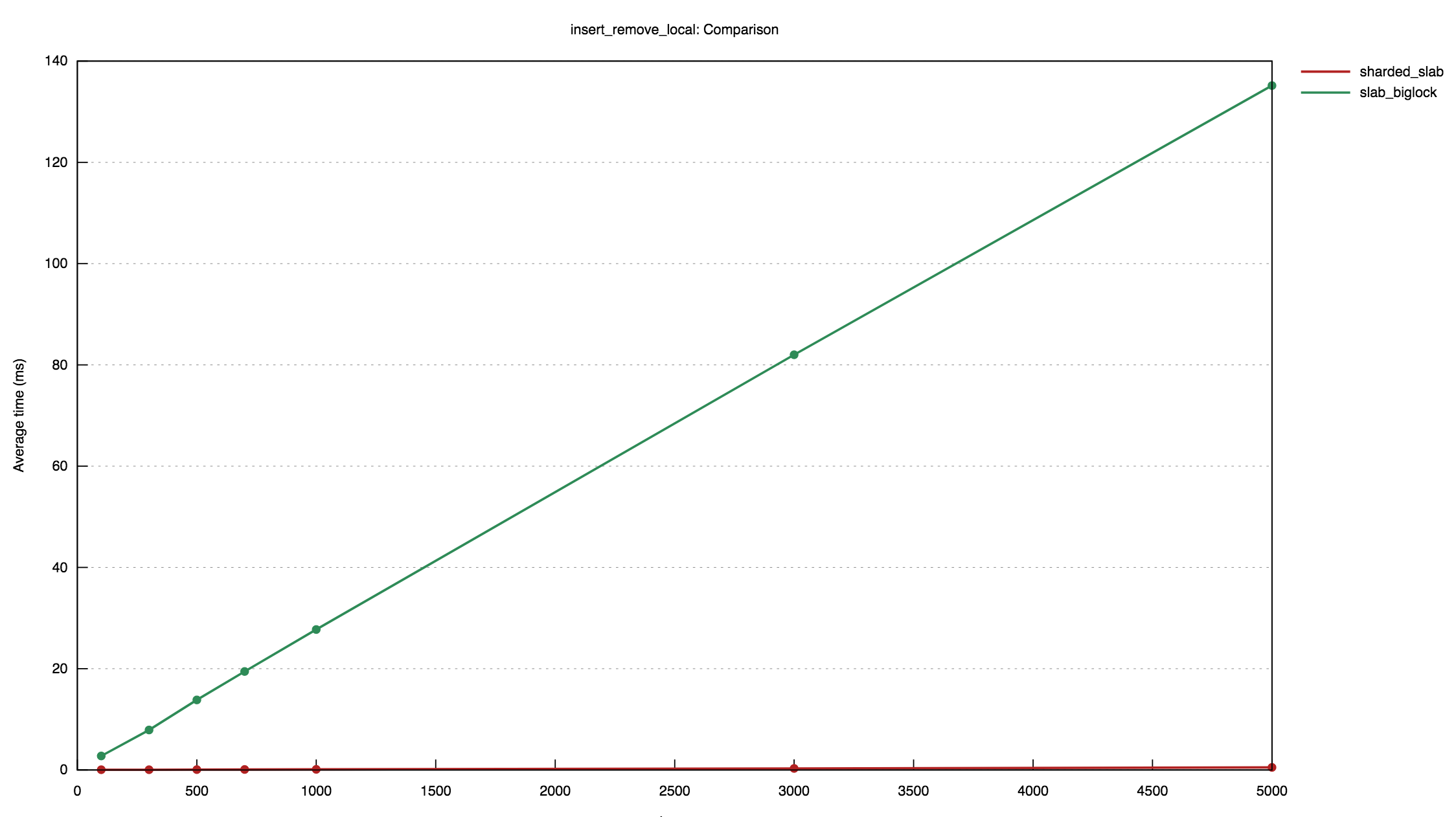
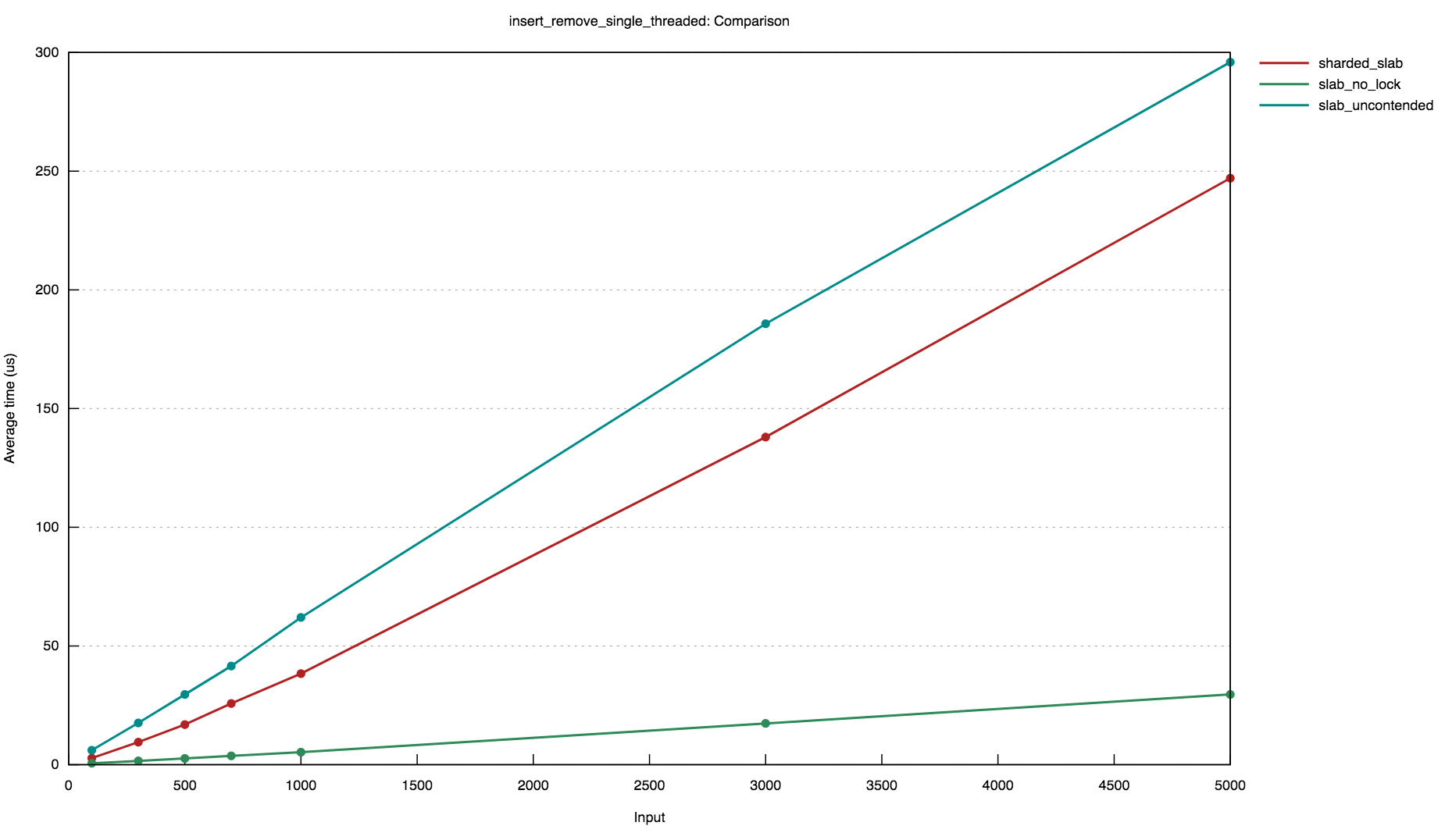
These graphs were produced by out-of-tree `criterion` benchmarks of the
sharded slab implementation.


The first shows the results of a benchmark where an increasing number of
items are inserted and then removed into a slab concurrently by five
threads. It compares the performance of the sharded slab implementation
with a `RwLock<slab::Slab>`:

<img width="1124" alt="Screen Shot 2019-10-01 at 5 09 49 PM" src="https://user-images.githubusercontent.com/2796466/66078398-cd6c9f80-e516-11e9-9923-0ed6292e8498.png">

The second graph shows the results of a benchmark where an increasing
number of items are inserted and then removed by a _single_ thread. It
compares the performance of the sharded slab implementation with an
`RwLock<slab::Slab>` and a `mut slab::Slab`.

<img width="925" alt="Screen Shot 2019-10-01 at 5 13 45 PM" src="https://user-images.githubusercontent.com/2796466/66078469-f0974f00-e516-11e9-95b5-f65f0aa7e494.png">

Note that while the `mut slab::Slab` (i.e. no read-write lock) is
(unsurprisingly) faster than the sharded slab in the single-threaded
benchmark, the sharded slab outperforms the un-contended
`RwLock<slab::Slab>`. This case, where the lock is uncontended and only
accessed from a single thread, represents the best case for the current
use of `slab` in `tokio-net`, since the lock cannot be conditionally
removed in the single-threaded case.

These benchmarks demonstrate that, while the sharded approach introduces
a small constant-factor overhead, it offers significantly better
performance across concurrent accesses.

## Notes

This branch removes the following dependencies `tokio-net`:
- `parking_lot`
- `num_cpus`
- `crossbeam_util`
- `slab`

This branch adds the following dev-dependencies:
- `proptest`
- `loom`

Note that these dev dependencies were used to implement tests for the
sharded-slab crate out-of-tree, and were necessary in order to vendor
the existing tests. Alternatively, since the implementation is tested
externally, we _could_ remove these tests in order to avoid picking up
dev-dependencies. However, this means that we should try to ensure that
`tokio-net`'s vendored implementation doesn't diverge significantly from
upstream's, since it would be missing a majority of its tests.

Signed-off-by: Eliza Weisman <[email protected]>
The standard library's `io` module has small utilities such as `repeat`,
`empty`, and `sink`, which return `Read` and `Write` implementations.
These can come in handy in some circiumstances. `tokio::io` has no
equivalents that implement `AsyncRead`/`AsyncWrite`.

This commit adds `repeat`, `empty`, and `sink` helpers to `tokio::io`.
* net: switch from `log` to `tracing`.

Motivation:

The `tracing` crate implements scoped, structured, context-aware
diagnostics, which can add significant debugging value over unstructured
log messages. `tracing` is part of the Tokio project. As part of the
`tokio` 0.2 changes, I thought it would be good to move over from `log`
to `tracing` in the tokio runtime.

Solution:

This branch replaces the use of `log` in `tokio-net` with
`tracing`. I've tried to leave all the instrumentation points more or
less the same, but modified to use structured fields instead of string
interpolation.

Notes:

I removed the timing in `Reactor::poll` in favor of simply adding a
`#[tracing::instrument]` attribute. Since the generated `tracing` span
will have enter and exit events, a `tracing::Subscriber`
implemementation can use those to record timestamps, and process that
timing data in a much more sophisticated manner than including it in a
log line.

We can add the timestamps back if they're desired.

Signed-off-by: Eliza Weisman <[email protected]>
## Motivation

The `tracing` crate implements scoped, structured, context-aware
diagnostics, which can add significant debugging value over unstructured
log messages. `tracing` is part of the Tokio project. As part of the
`tokio` 0.2 changes, I thought it would be good to move over from `log`
to `tracing` in the tokio runtime. Updating the executor crate is an obvious
starting point.

## Solution

This branch replaces the use of `log` in `tokio-executor` with
`tracing`. I've tried to leave all the instrumentation points more or
less the same, but modified to use structured fields instead of string
interpolation. I've also added a few `tracing` spans, primarily in
places where a variable is added to all the log messages in a scope.

## Notes

For users who are using the legacy `log` output, there is a feature flag
to enable `log` support in `tracing`. I thought about making this on by
default, but that would also enable the `tracing` dependency by default,
and it is only pulled in when the `threadpool` feature flag is enabled.
The `tokio` crate could enable the log feature in its default features
instead, since the threadpool feature is on by default in `tokio`. If
this isn't the right approach, I can change how `log` back-compatibility
is enabled.

We might want to consider adding more `tracing` spans in the threadpool
later. This could be useful for profiling, and for helping users debug
the way their applications interact with the executor. This branch is
just intended as a starting point so that we can begin emitting
`tracing` data from the executor; we should revisit what instrumentation
should be exposed, as well.

Signed-off-by: Eliza Weisman <[email protected]>
## Motivation

Currently, the process for releasing a new version of a Tokio crate is
somewhat complex, and is not well-documented. To make it easier for
contributors to release minor versions more frequently, there should be
documentation describing this process.

## Solution

This branch adds a section to `CONTRIBUTING.md` describing how to
release a new version of a Tokio crate. The steps are based on those
described by @carllerche in an offline conversation.

I've also added a quick shell script to actually publish new crate
versions. This should make it harder to make mistakes when
publishing.

Signed-off-by: Eliza Weisman <[email protected]>
## Motivation
The `tokio-trace` and `tokio-trace-core` crates have been renamed to
`tracing` and `tracing-core`, and moved to their own repository
(`tokio-rs/tracing`).
## Solution
This branch removes `tokio-trace` and `tokio-trace-core` from the
`tokio` repository. In addition, I've added a "Related Projects" section
to the root README, which lists `tracing` (as well as `mio`, and
`bytes`) as other libraries maintained by the Tokio project. I thought
that this would help folks looking for `tokio-trace` here find it in its
new home.
In addition, it changes `tokio` to depend on `tracing-core` rather than
`tokio-trace-core`.
Closes#1159
Signed-off-by: Eliza Weisman <[email protected]>
Currently, when the `trace_span!`, `debug_span!`, `info_span!`,
`warn_span!`, and `error_span!` macros are invoked with an explicit
parent, a name, and zero or more fields (no target), the macros don't
pass along the explicitly provided parent when expanding to the `span!`
macro. This is likely due to an oversight on my part.

This branch fixes these macros by adding the parent into the `span!`
macro expansion. I've also added a test to catch regressions

Shoutout to @jonhoo for catching this one!

Signed-off-by: Eliza Weisman <[email protected]>
While we're making breaking changes to `tokio-trace`, it would be good
to get rid of the `AsId` trait. The goal of span functions that are
generic over `Span`/`Id` can be achieved without the unnecessary
complexity of defining a new trait. This would also make the API added
to `tokio_trace_core::Event` in #1109 more consistent with the
`tokio-trace::Span` API.
This branch removes `AsId` from `tokio-trace` and replaces its uses with
`impl Into<Option<Id>>` and `impl Into<Option<&'a Id>>`. While `AsRef`
might be more semantically correct for the borrowed-`Id` conversion, its
signature doesn't permit conversion into an `Option`. Implementations of
`Into<Option<Id>>` and `Into<Option<&'a Id>>` have been added for
`tokio_trace::Span`.
This is _technically_ a breaking API change, as it changes function
signatures. However, the existing macro syntax still works as-is, and
the tests which pass `&Id`, `&Span`, and `&Option<Id>` to the span
macros all still compile after this change.
Closes#1143
Signed-off-by: Eliza Weisman <[email protected]>
## Motivation
A common pattern in `tokio-trace` is to use the value of a local
variable as a field on a span or event. Currently, this requires code
like:
```rust
info!(foo = foo);
```
which is not particularly ergonomic given how commonly this occurs.
Struct initializers support a shorthand syntax for fields where the name
of the field is the same as a local variable, and `tokio-trace` should
as well.
## Solution
This branch adds support for syntax like
```rust
let foo = ...;
info!(foo);
```
and
```rust
let foo = Foo {
bar: ...,
...
};
info!(foo.bar)
```
to the `tokio-trace` span and event macros. This syntax also works with
the `Debug` and `Display` field shorthand.
The span macros previously used a field name with no value to indicate
an uninitialized field. A new issue, #1138, has been opened for finding a
replacement syntax for uninitialized fields. Until then, the `tokio-trace`
macros will no longer provide a way to create fields without values,
although the `-core` API will continue to support this.
Closes#1062
Signed-off-by: Eliza Weisman <[email protected]>
## Motivation
Currently, the primary way to use a span is to use `.enter` and pass a
closure to be executed under the span. While that is convenient in many
settings, it also comes with two decently inconvenient drawbacks:
- It breaks control flow statements like `return`, `?`, `break`, and
`continue`
- It require re-indenting a potentially large chunk of code if you wish
it to appear under a span
## Solution
This branch changes the `Span::enter` function to return a scope guard
that exits the span when dropped, as in:
```rust
let guard = span.enter();
// code here is within the span
drop(guard);
// code here is no longer within the span
```
The method previously called `enter`, which takes a closure and
executes it in the span's context, is now called `Span::in_scope`, and
was reimplemented on top of the new `enter` method.
This is a breaking change to `tokio-trace` that will be part of the
upcoming 0.2 release.
Closes#1075
Signed-off-by: Eliza Weisman <[email protected]>
## Motivation
In `tokio-trace`, field values may be recorded as either a subset of
Rust primitive types or as `fmt::Display` and `fmt::Debug`
implementations. Currently, `tokio-trace` provides the `field::display`
and `field::debug` functions which wrap a type with a type that
implements `Value` using the wrapped type's `fmt::Display` or
`fmt::Debug` implementation. However, importing and using these
functions adds unnecessary boilerplate.
In #1081, @jonhoo suggested adding shorthand syntax to the macros,
similar to that used by the `slog` crate, as a solution for the
wordiness of the current API.
## Solution
This branch adds `?` and `%` sigils to field values in the span and
event macros, which expand to the `field::debug` and `field::display`
wrappers, respectively. The shorthand sigils may be used in any position
where the macros take a field value.
For example:
```rust
trace_span!("foo", my_field = ?something, ...); // shorthand for `debug`
info!(foo = %value, bar = false, ...) // shorthand for `display`
```
Adding this shorthand required a fairly large change to how field
key-value pairs are handled by the macros --- since `%foo` and `%foo`
are not valid Rust expressions, we can no longer match repeated
`$ident = $expr` patterns, and must now match field lists as repeated
token trees. The inner helper macros for constructing `FieldSet`s and
`ValueSet`s have to parse the token trees recursively. This added a
decent chunk of complexity, but fortunately we have a large number of
compile tests for the macros and I'm quite confident that all existing
invocations will still work.
Closes#1081
Signed-off-by: Eliza Weisman <[email protected]>
This branch changes `dispatcher::get_default` to unset the thread's
current dispatcher while the reference to it is held by the closure.
This prevents infinite loops if the subscriber calls code paths which
emit events or construct spans.
Note that this also means that nested calls to `get_default` inside of a
`get_default` closure will receive a `None` dispatcher rather than the
"actual" dispatcher. However, it was necessary to unset the default in
`get_default` rather than in dispatch methods such as `Dispatch::enter`,
as when those functions are called, the current state has already been
borrowed.
Before:
```
test enter_span ... bench: 3 ns/iter (+/- 0)
test span_no_fields ... bench: 51 ns/iter (+/- 12)
test span_repeatedly ... bench: 5,073 ns/iter (+/- 1,528)
test span_with_fields ... bench: 56 ns/iter (+/- 49)
test span_with_fields_record ... bench: 363 ns/iter (+/- 61)
```
After:
```
test enter_span ... bench: 3 ns/iter (+/- 0)
test span_no_fields ... bench: 35 ns/iter (+/- 12)
test span_repeatedly ... bench: 4,165 ns/iter (+/- 298)
test span_with_fields ... bench: 48 ns/iter (+/- 12)
test span_with_fields_record ... bench: 363 ns/iter (+/- 91)
```
Closes#1032
Signed-off-by: Eliza Weisman <[email protected]>
## Motivation
To ease the implementation of `Subscriber::register_callsite`, a field
should be added to `Metadata` to indicate if this callsite is an event or
a span.
## Solution
A new struct, `Kind`, is added to the `metadata` module in
`tokio-trace-core`, and a `Kind` field is added to the `Metadata`
struct. Macros which construct `metadata` now require a `Kind`.
`Kind` is represented as a struct with a private inner enum to allow new
`Kind`s to be added without breaking changes. However, the _addition_ of
the kind field _is_ a breaking change. While this could be done in a
backward-compatible way, it would permit the construction of metadata
with unknown kinds, and since the next `tokio-trace-core` release will
be a breaking change, I opted to make the breaking change instead.
New API tests for the `callsite!` and `metadata!` macros have been added
to guard against future API breakage.
Fixes: #986Closes: #1008
Co-Authored-By: csmoe <[email protected]>
## Motivation

The `Span::enter` function previously required an `&mut` reference to
enter a span. This is a relic of an earlier design where span closure
logic was determined by dropping an inner span component, and is no
longer strictly necessary.

Requiring `&mut self` to enter a span leads to awkward patterns in cases
when a user wishes to enter a span and then call methods on the span
(such as recording field values). For example, we cannot say
```rust
let mut span = span!("foo", bar);
span.enter(|| {
    span.record("bar" &false);
});
```
since the span is mutably borrowed by `enter`. Instead, we must clone
the span, like so:
```rust
let mut span = span!("foo", bar);
span.clone().enter(|| {
    span.record("bar" &false);
});
```

Having to clone the span is somewhat less ergonomic, and it has
performance disadvantages as well: cloning a `Span` will clone the
span's `Dispatch` handle, requiring an `Arc` bump, as well as calling
the `Subscriber`'s `clone_span` and `drop_span` functions. If we can
enter spans without a mutable borrow, we don't have to update any of
these ref counts.

The other reason we may wish to require mutable borrows to enter a span
is if we want to disallow entering a span multiple times before exiting
it. However, it is trivially possible to re-enter a span on the same
thread regardless, by cloning the span and entering it twice. Besides,
there may be a valuable semantic meaning in entering a span from inside
itself, such as when a function is called recursively, so disallowing
this is not a goal.

## Solution

This branch rewrites the `Span::enter`, `Span::record`, and
`Span::record_all` functions to no longer require mutable borrows.

In the case of `record` and `record_all`, this was trivial, as borrowing
mutably was not actually *necessary* for those functions. For `enter`,
the `Entered` guard type was reworked to consist of an `&'a Inner`
rather than an `Inner`, so it is no longer necessary to `take` the
span's `Inner`.

## Notes

In addition to allowing spans to be entered without mutable borrows,
`Entered` was changed to exit the span automatically when the guard is
dropped, so we may now observe correct span exits even when unwinding.

Furthermore, this allows us to simplify the `enter` function a bit,
leading to a minor performance improvement when entering spans.

Before:
```
test enter_span              ... bench:          13 ns/iter (+/- 1)
```

...and after:
```
test enter_span              ... bench:           3 ns/iter (+/- 1)
```

Note that this branch also contains a change to make the
`subscriber::enter_span` benchmark more accurate. Previously, this
benchmark constructed a new span inside of `b.iter(|| {...})`. This
means that the benchmark was measuring not only the time taken to enter
a span, but the time taken to construct a `Span` handle as well.
However, we already have benchmarks for span construction, and the
intention of this particular benchmark was to measure the overhead of
constructing a span.

I've updated the benchmark by moving the span construction out of the
`iter` closure. Now, the span is constructed a single time and entered
on every iteration. This allows us to measure only the overhead of
actually entering a span. The "before" benchmark numbers above were
recorded after backporting this change to master, so they are "fair" to
the previous implementation. Prior to this change the benchmark took
approximately 53 ns.

Signed-off-by: Eliza Weisman <[email protected]>
## Motivation
In order to support conventions that add namespacing to `tokio-trace`
field names, it's necessary to accept at least one type of separator
character. Currently, the `tokio-trace` macros only accept valid Rust
identifiers, so there is no clear separator character for namespaced
conventions. See also #1018.
## Solution
This branch changes the single `ident` fragment matcher for field names
to match *one or more* `ident` fragments separated by `.` characters.
## Notes
The resulting key is still exposed to `tokio-trace-core` as a string
constant created by stringifying the dotted expression. However, if
`tokio-trace-core` were later to adopt a first class notion of
hierarchical field keys, we would be able to track that change in
`tokio-trace` as an implementation detail.
Closes#1018.
Closes#1022.
Signed-off-by: Eliza Weisman <[email protected]>
This branch fixes the `tokio-trace` Subscriber benchmarks panicking due
to constructing spans with ID 0. They will now use an arbitrary constant
instead.

Signed-off-by: Eliza Weisman <[email protected]>
This branch modifies the `tokio_trace::Span` API functions that take
span IDs (the `Span::child_of` constructor, and the `Span::follows_from`
method) so that more types bearing a span ID can be passed as an
argument. Span IDs may now be passed directly without requiring them to
be passed as `Some(id)`. This should make the API slightly more
ergonomic.

Also, it changes the `Span::field` method to take an `AsField` rather
than a `Borrow<str>`.

Signed-off-by: Eliza Weisman <[email protected]>
This branch improves the `fmt::Debug` implementation for `Metadata`,
and adds `fmt::Display` implementations for `FieldSet` and `ValueSet`.

When formatting a `Metadata`, only present fields are formatted --- if
optional fields, such as the file, line number, and module path are
`None`, they will be excluded. In addition, `Metadata` now formats its
`FieldSet` using `FieldSet`'s `fmt::Display` implementation, which is a
bit less noisy. Finally, the `Debug` output for `Metadata` now includes
the callsite that the metadata originates from.

The intention behind these changes is to make the output from failed
tests somewhat easier to interpret.

Signed-off-by: Eliza Weisman <[email protected]>
## Motivation

`tokio-trace` currently offers a strategy for compatibility with the
`log` crate: its macros can be dropped in as a replacement for `log`'s
macros, and a subscriber can be used that translates trace events to log
records. However, this requires the application to be aware of
`tokio-trace` and manually set up this subscriber.

Many libraries currently emit `log` records, and would like to be able
to emit `tokio-trace` instrumentation instead. The `tokio` runtimes are
one such example. However, with the current log compatibility strategy,
replacing existing logging with trace instrumentation would break
`tokio`'s logs for any downstream user which is using only `log` and not
`tokio-trace`. It is desirable for libraries to have the option to emit
both `log` _and_ `tokio-trace` diagnostics from the same instrumentation
points.

## Solution

This branch adds a `log` feature flag to the `tokio-trace` crate, which
when set, causes `tokio-trace` instrumentation to emit log records as well
as `tokio-trace` instrumentation.

## Notes

In order to allow spans to log their names when they are entered and
exited even when the span is disabled, this branch adds an
`&'static Metadata` to the `Span` type. This was previously stored in
the `Inner` type and was thus only present when the span was enabled.
This makes disabled spans one word longer, but enabled spans remain
the same size.

Fixes: #949

Signed-off-by: Eliza Weisman <[email protected]>
## Motivation

In order to implement "out of band" `Subscriber` APIs in third-party
subscriber implementations (see [this comment]) users may want to
downcast the current `Dispatch` to a concrete subscriber type.

For example, in a library for integrating `tokio-trace` with a fancy new
(hypothetical) distributed tracing technology "ElizaTracing", which uses
256-bit span IDs, we might expect to see a function like this:
```rust

pub fn correlate(tt: tokio_trace::span::Id, et: elizatracing::SpanId) {
    tokio_trace::dispatcher::with(|c| {
        if let Some(s) = c.downcast_ref::<elizatracing::Subscriber>() {
            s.do_elizatracing_correlation_magic(tt, et);
        }
    });
}
```

This allows users to correlate `tokio-trace` IDs with IDs in the
distributed tracing system without having to pass a special handle to
the subscriber through application code (as one is already present in
thread-local storage, but with its type erased).

## Solution

This branch makes the following changes:
 * Add an object-safe `downcast_raw` method to the `Subscriber` trait,
   taking a `TypeId` and returning an `*const ()` if the type ID
   matches the subscriber's type ID, or `None` if it does not, and
 * Add `is<T>` and `downcast_ref<T>` functions to `Subscriber`
   and `Dispatch`, using `downcast_raw`.

Unlike the approach implemented in #950, the `downcast_raw` method is
object-safe, since it takes a `TypeId` rather than a type _parameter_
and returns a void pointer rather than an `&T`. This means that
`Subscriber` implementations can override this method if necessary. For
example, a `Subscriber` that fans out to multiple component subscribers
can downcast to their component parts, and "chained" or "middleware"
subscribers, which wrap an inner `Subscriber` and modify its behaviour
somehow, can downcast to the inner type if they choose to.

[this comment]: https://github.com/tokio-rs/tokio/issues/932#issuecomment-469473501
[`std::error::Error`'s]: https://doc.rust-lang.org/1.33.0/src/std/error.rs.html#204

Refs: #950, #953, https://github.com/tokio-rs/tokio/issues/948#issuecomment-469444293

Signed-off-by: Eliza Weisman <[email protected]>
* chore: Fix examples not working with `cargo run`

## Motivation

PR #991 moved the `tokio` crate to its own subdirectory, but did not
move the `examples` directory into `tokio/examples`. While attempting to
use the examples for testing another change, I noticed that #991 had
broken the ability to use `cargo run`, as the examples were no longer
considered part of a crate that cargo was aware of:

```
tokio on master [$] via 🦀v1.33.0 at ☸️ aks-eliza-dev
➜  cargo run --example chat
error: no example target named `chat`

Did you mean `echo`?
```

## Solution

This branch moves the examples into the `tokio` directory, so cargo is
now once again aware of them:

```
tokio on eliza/fix-examples [$] via 🦀v1.33.0 at ☸️ aks-eliza-dev
➜  cargo run --example chat
   Compiling tokio-executor v0.1.7 (/Users/eliza/Code/tokio/tokio-executor)
   Compiling tokio-reactor v0.1.9
   Compiling tokio-threadpool v0.1.13
   Compiling tokio-current-thread v0.1.6
   Compiling tokio-timer v0.2.10
   Compiling tokio-uds v0.2.5
   Compiling tokio-udp v0.1.3
   Compiling tokio-tcp v0.1.3
   Compiling tokio-fs v0.1.6
   Compiling tokio v0.1.18 (/Users/eliza/Code/tokio/tokio)
    Finished dev [unoptimized + debuginfo] target(s) in 7.04s
     Running `target/debug/examples/chat`
server running on localhost:6142
```

Signed-off-by: Eliza Weisman <[email protected]>

Signed-off-by: Eliza Weisman <[email protected]>
This branch makes the following changes to `tokio-trace`'s `Span` type:

* **Remove manual close API from spans**
  In practice, there wasn't really a use-case for this, and it
  complicates the implementation a bit. We can always add it back later.

* **Remove generic lifetime from `Span`**
  Again, there wasn't actually a use-case for spans with metadata that
  doesn't live for the static lifetime, and it made using `Span`s in
  other types somewhat inconvenient. It's also possible to implement an
  alternative API for non-static spans on top of the `tokio-trace-core`
  primitives.

Signed-off-by: Eliza Weisman <[email protected]>
PR #973 changed the `tokio_trace_core::span::Id::from_u64` function to
require that the provided `u64` be greater than zero. However, I had
forgotten that the implementation of `Subscriber` for the `NoSubscriber`
type (which is used when no default subscriber is set) always returned
`span::Id::from_u64(0)` from its `new_span` method. In combination with
the assert added in #973, this means that every time a span is hit when
no subscriber is set, `tokio-trace-core` will panic.

This branch fixes the panics by having `NoSubscriber` construct span IDs
using a different (arbitrarily chosen) non-zero constant.

Signed-off-by: Eliza Weisman <[email protected]>
This branch changes `tokio_trace_core::span::Id::from_u64` to assert
that the integer from which the span ID is constructed is greater than
zero. This is to enable future use of non-zero optimization.

Unfortunately, we can't actually use a `NonZeroU64` _now_, as that type
was only stabilized in Rust 1.28.0, and `tokio`'s current minimum
supported Rust version is 1.26.0.

Adding and documenting the assertion now allows us to change the
internal representation to `NonZeroU64` later (when 1.28.0 is the
minimum supported Rust version), without causing a breaking change.

Signed-off-by: Eliza Weisman <[email protected]>
* trace-core: Pass dispatcher by ref to `dispatcher::with_default`

As requested by @carllerche in https://github.com/tokio-rs/tokio/pull/966#discussion_r264380005, this branch changes the
`dispatcher::with_default` function in `tokio-trace-core` to take the
dispatcher by ref and perform the clone internally. This makes this
function more consistant with other `with_default` functions in other
crates.

Signed-off-by: Eliza Weisman <[email protected]>

* trace: Don't set the default dispatcher on entering a span

Setting the default dispatcher on span entry is a relic of when spans
tracked their parent's ID. At that time, it was necessary to ensure that
any spans created inside a span were observed by the same subscriber
that originally provided the entered span with an ID, as otherwise, new
spans would be created with parent IDs that did not originate from that
subscriber.

Now that spans don't track their parent ID, this is no longer necessary.
However, removing this behavior does mean that if a span is entered
outside of the subscriber context it was created in, any subsequent
spans will be observed by the current default subscriber and thus will
not be part of the original span's trace tree. Since subscribers are not
expected to change frequently, and spans are not expected to move
between them, this is likely acceptable.

I've removed the tests for the old behavior.

Note that this change improves the performance of span entry/exit fairly
significantly. Here are the results of running a benchmark that enters
a span, does nothing, and immediately exits it, before this change:

```
test enter_span              ... bench:          93 ns/iter (+/- 14)
```

...and after:

```
test enter_span              ... bench:          51 ns/iter (+/- 9)
```

Signed-off-by: Eliza Weisman <[email protected]>
## Motivation
Currently, it isn't possible to import individual macros from
`tokio-trace` using the macros 1.2 syntax:
```rust
use tokio_trace::{debug, info, span};
```
This is because these macros require that `callsite` and `enabled` are
imported as well.
## Solution
This branch resolves the problem by adding the [`local_inner_macros`]
attribute to the instrumentation API's macros. This allows other macros
from within the crate to be used without requiring them to be explicitly
imported.
However, this also requires duplicating any macros from other sources
(such as std and `tokio-trace-core`) with wrappers due to the behaviour
of `local_inner_macros`. I've added these wrapper macros as well.
Since the macros got even longer as a result of this, I've moved them
to a separate file to make `lib.rs` easier to read. I've also wrapped
some very long lines in the macros, and removed the explicit drop of
the result of evaluating some event macros (it's no longer necessary
as all event macros now evaluate to `()`).
[`local_inner_macros`]: https://doc.rust-lang.org/nightly/edition-guide/rust-2018/macros/macro-changes.html#local-helper-macrosFixes#968
Signed-off-by: Eliza Weisman <[email protected]>
This branch makes a handful of `tokio-trace-core` API improvements, mostly
around naming. In particular:
* Rename `dispatcher::with` to `dispatcher::get_default`
* Rename `Event::observe` to `Event::dispatch`
* Make `field::ValidLen` trait private
Closes#948Closes#960
Signed-off-by: Eliza Weisman <[email protected]>
This branch changes the `Subscriber::record` method to take a new
arguments struct, `span::Record`. The `field::Record` trait was renamed
to `field::Visit` to prevent name conflicts.

In addition, the `ValueSet::is_empty`, `ValueSet::contains`, and
`ValueSet::record` methods were made crate-private, as they are exposed
on the `Attributes` and `Record` types.

Signed-off-by: Eliza Weisman <[email protected]>
This branch allows users of `tokio-trace` to explicitly set a span's
parent, or indicate that a span should be a new root of its own trace
tree. A `parent: ` key has been added to the `span!` macros. When a span
is provided, that span will be set as the parent, while `parent: None`
will result in a new root span. No `parent:` key results in the current
behaviour.
A new type, `span::Attributes`, was added to `tokio-trace-core` to act
as an arguments struct for the `Subscriber::new_span` method. This will
allow future fields to be added without causing breaking API changes.
The `Attributes` struct currently contains the new span's metadata,
`ValueSet`, and parent.
Finally, the `span::Span` type in `-core` was renamed to `span::Id`, for
consistency with `tokio-trace` and to differentiate it from
`span::Attributes`. This name was chosen primarily due to precedent in
other tracing systems.
Closes#920
Signed-off-by: Eliza Weisman <[email protected]>
This branch adds links to the master RustDoc published by CI to the
`tokio-trace` and `tokio-trace-core` README. In addition, it fixes a
broken links in the RustDoc for `tokio-trace` and updates the
`tokio-trace-core` RustDoc to match the README.

Signed-off-by: Eliza Weisman <[email protected]>
<!-- Thank you for your Pull Request. Please provide a description above
and review the requirements below.
Bug fixes and new features should include tests.
Contributors guide:
https://github.com/tokio-rs/tokio/blob/master/CONTRIBUTING.md -->
## Motivation
In asynchronous systems like Tokio, interpreting traditional log
messages can often be quite challenging. Since individual tasks are
multiplexed on the same thread, associated events and log lines are
intermixed making it difficult to trace the logic flow. Currently, none
of the available logging frameworks or libraries in Rust offer the
ability to trace logical paths through a futures-based program.
There also are complementary goals that can be accomplished with such a
system. For example, metrics / instrumentation can be tracked by
observing emitted events, or trace data can be exported to a distributed
tracing or event processing system.
In addition, it can often be useful to generate this diagnostic data in
a structured manner that can be consumed programmatically. While prior
art for structured logging in Rust exists, it is not currently
standardized, and is not "Tokio-friendly".
## Solution
This branch adds a new library to the tokio project, `tokio-trace`.
`tokio-trace` expands upon logging-style diagnostics by allowing
libraries and applications to record structured events with additional
information about *temporality* and *causality* --- unlike a log
message, a span in `tokio-trace` has a beginning and end time, may be
entered and exited by the flow of execution, and may exist within a
nested tree of similar spans. In addition, `tokio-trace` spans are
*structured*, with the ability to record typed data as well as textual
messages.
The `tokio-trace-core` crate contains the core primitives for this
system, which are expected to remain stable, while `tokio-trace` crate
provides a more "batteries-included" API. In particular, it provides
macros which are a superset of the `log` crate's `error!`, `warn!`,
`info!`, `debug!`, and `trace!` macros, allowing users to begin the
process of adopting `tokio-trace` by performing a drop-in replacement.
## Notes
Work on this project had previously been carried out in the
[tokio-trace-prototype] repository. In addition to the `tokio-trace` and
`tokio-trace-core` crates, the `tokio-trace-prototype` repo also
contains prototypes or sketches of adapter, compatibility, and utility
crates which provide useful functionality for `tokio-trace`, but these
crates are not yet ready for a release. When this branch is merged, that
repository will be archived, and the remaining unstable crates will be
moved to a new `tokio-trace-nursery` repository. Remaining issues on the
`tokio-trace-prototype` repo will be moved to the appropriate new repo.
The crates added in this branch are not _identical_ to the current head
of the `tokio-trace-prototype` repo, as I did some final clean-up and docs
polish in this branch prior to merging this PR.
[tokio-trace-prototype]: https://github.com/hawkw/tokio-trace-prototypeCloses: #561
Signed-off-by: Eliza Weisman <[email protected]>
Fixes: #681

## Motivation

Currently, a potential panic exists in `LengthDelimitedCodec::encode`.
Writing the length field to the `dst` buffer can exceed the buffer
capacity, as `BufMut::put_uint_{le,be}` doesn't reserve more capacity.

## Solution

This branch adds a call to `dst.reserve` to ensure that there's
sufficient remaining buffer capacity to hold the length field and
the frame, prior to writing the length field. Previously, capacity
was only reserved later in the function, when writing the frame
to the buffer, and we never reserved capacity for the length field.

I've also added a test that reproduces the issue. The test panics on
master, but passes after making this change.

Signed-off-by: Eliza Weisman <[email protected]>
## Motivation
Currently, there is a potential denial of service vulnerability in the
`lines` codec. Since there is no bound on the buffer that holds data
before it is split into a new line, an attacker could send an unbounded
amount of data without sending a `\n` character.
## Solution
This branch adds a `new_with_max_length` constructor for `LinesCodec`
that configures a limit on the maximum number of bytes per line. When
the limit is reached, the the overly long line will be discarded (in
`max_length`-sized increments until a newline character or the end of the
buffer is reached. It was also necessary to add some special-case logic
to avoid creating an empty line when the length limit is reached at the
character immediately _before_ a `\n` character.
Additionally, this branch adds new tests for this function, including a
test for changing the line limit in-flight.
## Notes
This branch makes the following changes from my original PR with
this change (#590):
- The whole too-long line is discarded at once in the first call to `decode`
that encounters it.
- Only one error is emitted per too-long line.
- Made all the changes requested by @carllerche in
https://github.com/tokio-rs/tokio/pull/590#issuecomment-420735023Fixes: #186
Signed-off-by: Eliza Weisman <[email protected]>
## Motivation

Currently, the `RUST_BACKTRACE` environment variable is set to `1` on
Travis CI builds:
https://github.com/tokio-rs/tokio/blob/0ca973a7ebc5b8a29beac1ccb6c73ef26ddcbf22/.travis.yml#L49
However, it's not set on AppVeyor. This can make debugging
Windows-specific CI failures challenging for developers on other
operating systems.

## Solution

This branch sets `RUST_BACKTRACE=1` on AppVeyor.

Signed-off-by: Eliza Weisman <[email protected]>
* codec: add new constructor `with_max_length ` to `LinesCodec`
* codec: add security note to docs

Signed-off-by: Eliza Weisman <[email protected]>

* Fix Rust 1.25 compatibility

* codec: Fix incorrect line lengths in tests (and add assertions)

Signed-off-by: Eliza Weisman <[email protected]>

* codec: Fix off-by-one error in lines codec

Signed-off-by: Eliza Weisman <[email protected]>

* codec: Fix call to decode rather than decode_eof in test

Signed-off-by: Eliza Weisman <[email protected]>

* codec: Fix incorrect LinesCodec::decode_max_line_length

This bug was introduced after the fix for the off-by-one error.
Fortunately, the doctests caught it.

Signed-off-by: Eliza Weisman <[email protected]>

* codec: Minor style improvements

Signed-off-by: Eliza Weisman <[email protected]>

* codec: Don't allow LinesCodec length limit to be set after construction

Signed-off-by: Eliza Weisman <[email protected]>

* codec: change LinesCodec to error and discard line when at max length

* codec: Fix build on Rust 1.25

The slice patterns syntax wasn't supported yet in that release.

Signed-off-by: Eliza Weisman <[email protected]>

* codec: Add test for out-of-bounds index when peeking

Signed-off-by: Eliza Weisman <[email protected]>

* codec: Fix out of bounds index

* codec: Fix incomplete comment

Signed-off-by: Eliza Weisman <[email protected]>

* codec: Add test for line decoder buffer underrun
This patch refactors `length_delimited` to be implemented as a `Codec` and
use the default `Framed` wrapper types.

The original implementation did not do this in order to support vectored writes in the
write half. However, this implementation would be more efficient with small frames anyway.

If vectored writes are to be explored in the future, then it should be done holistically.

Signed-off-by: Eliza Weisman <[email protected]>