 Eliza Weisman
7eb264a0d0
Eliza Weisman
7eb264a0d0
## Motivation

The `tokio_net::driver` module currently stores the state associated
with scheduled IO resources in a `Slab` implementation from the `slab`
crate. Because inserting items into and removing items from `slab::Slab`
requires mutable access, the slab must be placed within a `RwLock`. This
has the potential to be a performance bottleneck especially in the context of
the work-stealing scheduler where tasks and the reactor are often located on
the same thread.

`tokio-net` currently reimplements the `ShardedRwLock` type from
`crossbeam` on top of `parking_lot`'s `RwLock` in an attempt to squeeze
as much performance as possible out of the read-write lock around the
slab. This introduces several dependencies that are not used elsewhere.

## Solution

This branch replaces the `RwLock<Slab>` with a lock-free sharded slab
implementation.

The sharded slab is based on the concept of _free list sharding_
described by Leijen, Zorn, and de Moura in [_Mimalloc: Free List
Sharding in Action_][mimalloc], which describes the implementation of a
concurrent memory allocator. In this approach, the slab is sharded so
that each thread has its own thread-local list of slab _pages_. Objects
are always inserted into the local slab of the thread where the
insertion is performed. Therefore, the insert operation needs not be
synchronized.

However, since objects can be _removed_ from the slab by threads other
than the one on which they were inserted, removal operations can still
occur concurrently. Therefore, Leijen et al. introduce a concept of
_local_ and _global_ free lists. When an object is removed on the same
thread it was originally inserted on, it is placed on the local free
list; if it is removed on another thread, it goes on the global free
list for the heap of the thread from which it originated. To find a free
slot to insert into, the local free list is used first; if it is empty,
the entire global free list is popped onto the local free list. Since
the local free list is only ever accessed by the thread it belongs to,
it does not require synchronization at all, and because the global free
list is popped from infrequently, the cost of synchronization has a
reduced impact. A majority of insertions can occur without any
synchronization at all; and removals only require synchronization when
an object has left its parent thread.

The sharded slab was initially implemented in a separate crate (soon to
be released), vendored in-tree to decrease `tokio-net`'s dependencies.
Some code from the original implementation was removed or simplified,
since it is only necessary to support `tokio-net`'s use case, rather
than to provide a fully generic implementation.

[mimalloc]: https://www.microsoft.com/en-us/research/uploads/prod/2019/06/mimalloc-tr-v1.pdf

## Performance

These graphs were produced by out-of-tree `criterion` benchmarks of the
sharded slab implementation.


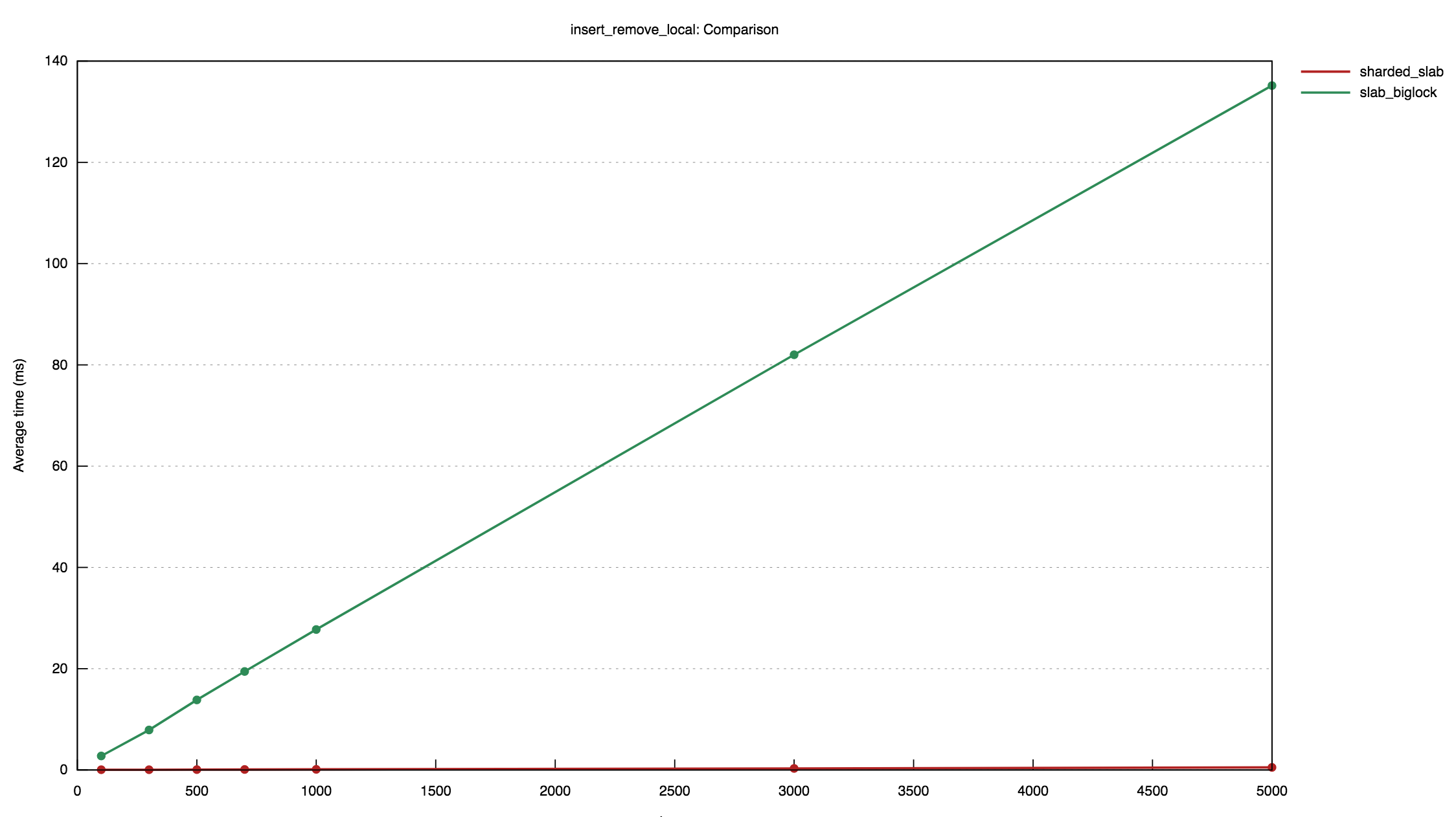
The first shows the results of a benchmark where an increasing number of
items are inserted and then removed into a slab concurrently by five
threads. It compares the performance of the sharded slab implementation
with a `RwLock<slab::Slab>`:

<img width="1124" alt="Screen Shot 2019-10-01 at 5 09 49 PM" src="https://user-images.githubusercontent.com/2796466/66078398-cd6c9f80-e516-11e9-9923-0ed6292e8498.png">

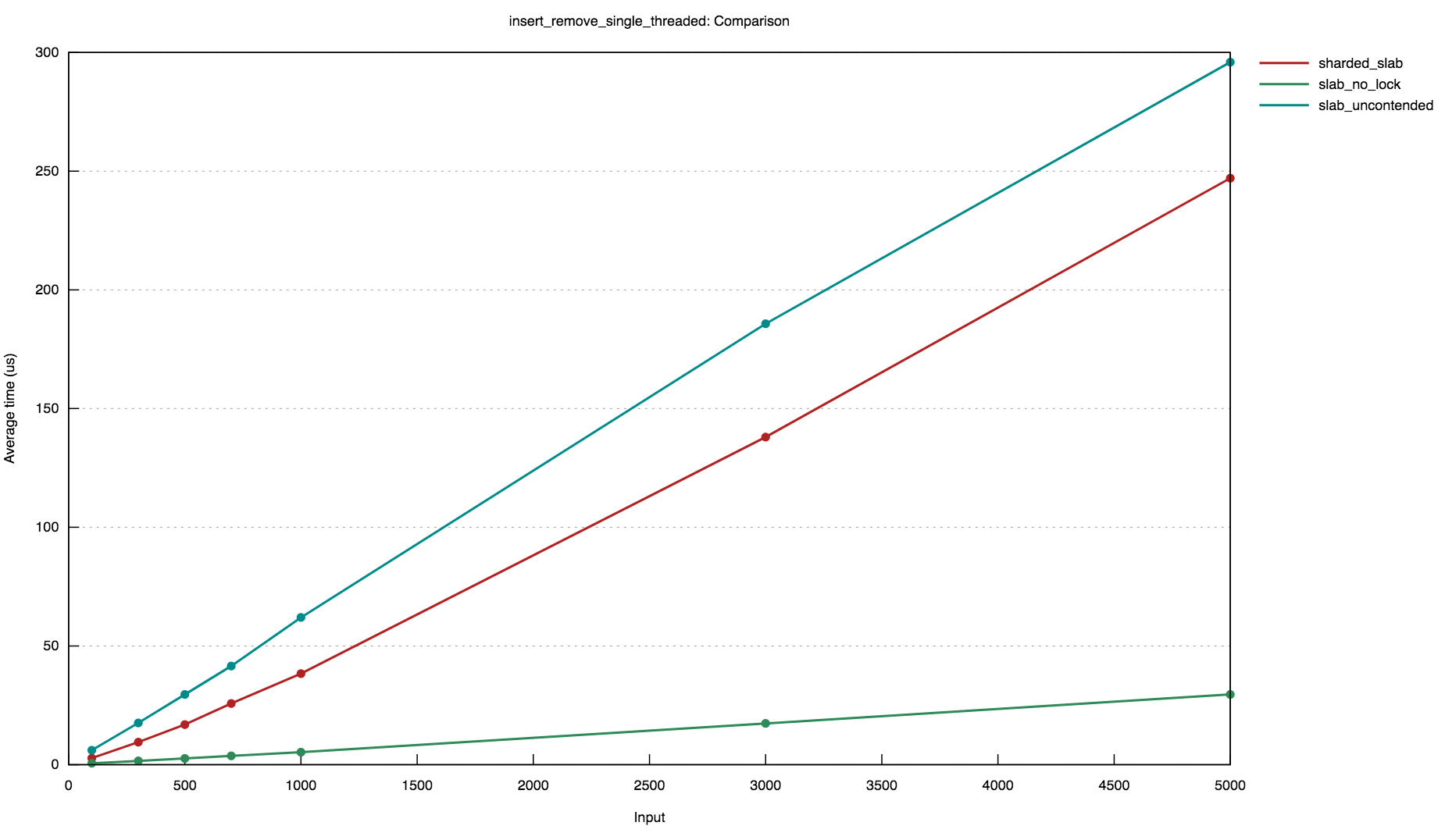
The second graph shows the results of a benchmark where an increasing
number of items are inserted and then removed by a _single_ thread. It
compares the performance of the sharded slab implementation with an
`RwLock<slab::Slab>` and a `mut slab::Slab`.

<img width="925" alt="Screen Shot 2019-10-01 at 5 13 45 PM" src="https://user-images.githubusercontent.com/2796466/66078469-f0974f00-e516-11e9-95b5-f65f0aa7e494.png">

Note that while the `mut slab::Slab` (i.e. no read-write lock) is
(unsurprisingly) faster than the sharded slab in the single-threaded
benchmark, the sharded slab outperforms the un-contended
`RwLock<slab::Slab>`. This case, where the lock is uncontended and only
accessed from a single thread, represents the best case for the current
use of `slab` in `tokio-net`, since the lock cannot be conditionally
removed in the single-threaded case.

These benchmarks demonstrate that, while the sharded approach introduces
a small constant-factor overhead, it offers significantly better
performance across concurrent accesses.

## Notes

This branch removes the following dependencies `tokio-net`:
- `parking_lot`
- `num_cpus`
- `crossbeam_util`
- `slab`

This branch adds the following dev-dependencies:
- `proptest`
- `loom`

Note that these dev dependencies were used to implement tests for the
sharded-slab crate out-of-tree, and were necessary in order to vendor
the existing tests. Alternatively, since the implementation is tested
externally, we _could_ remove these tests in order to avoid picking up
dev-dependencies. However, this means that we should try to ensure that
`tokio-net`'s vendored implementation doesn't diverge significantly from
upstream's, since it would be missing a majority of its tests.

Signed-off-by: Eliza Weisman <[email protected]>
Tokio
NOTE: Tokio's master is currently undergoing heavy development. This branch and the alpha releases will see API breaking changes and there are currently significant performance regressions that still need to be fixed before the final release. Use the v0.1.x branch for stable releases.
A runtime for writing reliable, asynchronous, and slim applications with the Rust programming language. It is:
-
Fast: Tokio's zero-cost abstractions give you bare-metal performance.
-
Reliable: Tokio leverages Rust's ownership, type system, and concurrency model to reduce bugs and ensure thread safety.
-
Scalable: Tokio has a minimal footprint, and handles backpressure and cancellation naturally.



Website | Guides | API Docs | Chat
Overview
Tokio is an event-driven, non-blocking I/O platform for writing asynchronous applications with the Rust programming language. At a high level, it provides a few major components:
- A multithreaded, work-stealing based task scheduler.
- A reactor backed by the operating system's event queue (epoll, kqueue, IOCP, etc...).
- Asynchronous TCP and UDP sockets.
These components provide the runtime components necessary for building an asynchronous application.
Example
A basic TCP echo server with Tokio:
use tokio::net::TcpListener;
use tokio::prelude::*;
use std::net::SocketAddr;

#[tokio::main]
async fn main() -> Result<(), Box<dyn std::error::Error>> {
    let addr = "127.0.0.1:8080".parse::<SocketAddr>()?;
    let mut listener = TcpListener::bind(&addr).await?;

    loop {
        let (mut socket, _) = listener.accept().await?;

        tokio::spawn(async move {
            let mut buf = [0; 1024];

            // In a loop, read data from the socket and write the data back.
            loop {
                let n = match socket.read(&mut buf).await {
                    // socket closed
                    Ok(n) if n == 0 => return,
                    Ok(n) => n,
                    Err(e) => {
                        println!("failed to read from socket; err = {:?}", e);
                        return;
                    }
                };

                // Write the data back
                if let Err(e) = socket.write_all(&buf[0..n]).await {
                    println!("failed to write to socket; err = {:?}", e);
                    return;
                }
            }
        });
    }
}
More examples can be found here. Note that the master branch
is currently being updated to use async / await. The examples are
not fully ported. Examples for stable Tokio can be found
here.
Getting Help
First, see if the answer to your question can be found in the Guides or the API documentation. If the answer is not there, there is an active community in the Tokio Gitter channel. We would be happy to try to answer your question. Last, if that doesn't work, try opening an issue with the question.
Contributing
🎈 Thanks for your help improving the project! We are so happy to have you! We have a contributing guide to help you get involved in the Tokio project.
Related Projects
In addition to the crates in this repository, the Tokio project also maintains several other libraries, including:
-
tracing(formerlytokio-trace): A framework for application-level tracing and async-aware diagnostics. -
mio: A low-level, cross-platform abstraction over OS I/O APIs that powerstokio. -
bytes: Utilities for working with bytes, including efficient byte buffers.
Supported Rust Versions
Tokio is built against the latest stable, nightly, and beta Rust releases. The minimum version supported is the stable release from three months before the current stable release version. For example, if the latest stable Rust is 1.29, the minimum version supported is 1.26. The current Tokio version is not guaranteed to build on Rust versions earlier than the minimum supported version.
License
This project is licensed under the MIT license.
Contribution
Unless you explicitly state otherwise, any contribution intentionally submitted for inclusion in Tokio by you, shall be licensed as MIT, without any additional terms or conditions.