* Add `TryInto<Stdio>` impls for `ChildStd{in,out,err}` for ergonomic
  conversions into `std::process::Stdio` so callers can perform the
  conversion without needing to manipulate raw fds/handles directly
* Removes duplicated code by moving it to `Registration`.
* impl `Deref` for `PollEvented` to avoid `get_ref()`.
* Avoid extra waker clones in I/O driver.
* Add `Interest` wrapper around `mio::Interest`.
* This changes the `Child::kill` to be an async method which awaits the
  child after sending a kill signal. This avoids leaving zombie
  processes on Unix platforms if the caller forgets to await the child
  after the kill completes
* A `start_kill` method was also added on `Child` which only sends the
  kill signal to the child process. This allows for kill signals to be
  sent even outside of async contexts.
* add Child::try_wait to mirror the std API
* replace Future impl on Child with `.wait()` method to bring our
  APIs closer to those in std and it allow us to
  internally fuse the future so that repeated calls to `wait` result in
  the same value (similar to std) without forcing the caller to fuse the
  outer future
* Also change `Child::id` to return an Option result to avoid
  allowing the caller to accidentally use the pid on Unix systems after
  the child has been reaped
* Also remove deprecated Child methods
This patch updates the coop logic so that the budget is only decremented
if a future makes progress (that is, if it returns `Ready`). This is
realized by restoring the budget to its former value after
`poll_proceed` _unless_ the caller indicates that it made progress.

The thinking here is that we always want tasks to make progress when we
poll them. With the way things were, if a task polled 128 resources that
could make no progress, and just returned `Pending`, then a 129th
resource that _could_ make progress would not be polled. Worse yet, this
could manifest as a deadlock, if the first 128 resources were all
_waiting_ for the 129th resource, since it would _never_ be polled.

The downside of this change is that `Pending` resources now do not take
up any part of the budget, even though they _do_ take up time on the
executor. If a task is particularly aggressive (or unoptimized), and
polls a large number of resources that cannot make progress whenever it
is polled, then coop will allow it to run potentially much longer before
yielding than it could before. The impact of this should be relatively
contained though, because tasks that behaved in this way in the past
probably ignored `Pending` _anyway_, so whether a resource returned
`Pending` due to coop or due to lack of progress may not make a
difference to it.
A single call to `poll` on a top-level task may potentially do a lot of
work before it returns `Poll::Pending`. If a task runs for a long period
of time without yielding back to the executor, it can starve other tasks
waiting on that executor to execute them, or drive underlying resources.
See for example rust-lang/futures-rs#2047, rust-lang/futures-rs#1957,
and rust-lang/futures-rs#869. Since Rust does not have a runtime, it is
difficult to forcibly preempt a long-running task.

Consider a future like this one:

```rust
use tokio::stream::StreamExt;
async fn drop_all<I: Stream>(input: I) {
    while let Some(_) = input.next().await {}
}
```

It may look harmless, but consider what happens under heavy load if the
input stream is _always_ ready. If we spawn `drop_all`, the task will
never yield, and will starve other tasks and resources on the same
executor.

This patch adds a `coop` module that provides an opt-in mechanism for
futures to cooperate with the executor to avoid starvation. This
alleviates the problem above:

```
use tokio::stream::StreamExt;
async fn drop_all<I: Stream>(input: I) {
    while let Some(_) = input.next().await {
        tokio::coop::proceed().await;
    }
}
```

The call to [`proceed`] will coordinate with the executor to make sure
that every so often control is yielded back to the executor so it can
run other tasks.

The implementation uses a thread-local counter that simply counts how
many "cooperation points" we have passed since the task was first
polled. Once the "budget" has been spent, any subsequent points will
return `Poll::Pending`, eventually making the top-level task yield. When
it finally does yield, the executor resets the budget before
running the next task.

The budget per task poll is currently hard-coded to 128. Eventually, we
may want to make it dynamic as more cooperation points are added. The
number 128 was chosen more or less arbitrarily to balance the cost of
yielding unnecessarily against the time an executor may be "held up".

At the moment, all the tokio leaf futures ("resources") call into coop,
but external futures have no way of doing so. We probably want to
continue limiting coop points to leaf futures in the future, but may
want to also enable third-party leaf futures to cooperate to benefit the
ecosystem as a whole. This is reflected in the methods marked as `pub`
in `mod coop` (even though the module is only `pub(crate)`). We will
likely also eventually want to expose `coop::limit`, which enables
sub-executors and manual `impl Future` blocks to avoid one sub-task
spending all of their poll budget.

Benchmarks (see tokio-rs/tokio#2160) suggest that the overhead of `coop`
is marginal.
This updates the tokio `Command` and `Child` behavior to match that of
the stdlib: spawned processes will *not* be automatically killed when
the handle is dropped

Unlike the stdlib, any dropped (unix) processes may be reaped by tokio
behind-the-scenes after they exit and if new processes are awaited,
which mitigates the risks of piling up unreaped zombie unix processes

A `Command::kill_on_drop` method is added to allow the caller to
control whether the spawned child should be killed when the handle is
dropped. By default, this value is `false`.

The `Child::forget` method has been removed, as it is superseded by
`Command::kill_on_drop`
Annotates types in `tokio::io` module with their required feature flag.
This annotation is included in generated documentation.

Notes:

* The annotation must be on the type or function itself. Annotating just
  the re-export is not sufficient.

* The annotation must be **inside** the `pin_project!` macro or it is
  lost.
Removes dependencies between Tokio feature flags. For example, `process`
should not depend on `sync` simply because it uses the `mpsc` channel.
Instead, feature flags represent **public** APIs that become available
with the feature enabled. When the feature is not enabled, the
functionality is removed. If another Tokio component requires the
functionality, it is stays as `pub(crate)`.

The threaded scheduler is now exposed under `rt-threaded`. This feature
flag only enables the threaded scheduler and does not include I/O,
networking, or time. Those features must be explictly enabled.

A `full` feature flag is added that enables all features.

`stdin`, `stdout`, `stderr` are exposed under `io-std`.

Macros are used to scope code by feature flag.
In an effort to reach API stability, the `tokio` crate is shedding its
_public_ dependencies on crates that are either a) do not provide a
stable (1.0+) release with longevity guarantees or b) match the `tokio`
release cadence. Of course, implementing `std` traits fits the
requirements.

The on exception, for now, is the `Stream` trait found in `futures_core`.
It is expected that this trait will not change much and be moved into `std.
Since Tokio is not yet going reaching 1.0, I feel that it is acceptable to maintain
a dependency on this trait given how foundational it is.

Since the `Stream` implementation is optional, types that are logically
streams provide `async fn next_*` functions to obtain the next value.
Avoiding the `next()` name prevents fn conflicts with `StreamExt::next()`.

Additionally, some misc cleanup is also done:

- `tokio::io::io` -> `tokio::io::util`.
- `delay` -> `delay_until`.
- `Timeout::new` -> `timeout(...)`.
- `signal::ctrl_c()` returns a future instead of a stream.
- `{tcp,unix}::Incoming` is removed (due to lack of `Stream` trait).
- `time::Throttle` is removed (due to lack of `Stream` trait).
-  Fix: `mpsc::UnboundedSender::send(&self)` (no more conflict with `Sink` fns).
## Motivation

The `tokio_net::driver` module currently stores the state associated
with scheduled IO resources in a `Slab` implementation from the `slab`
crate. Because inserting items into and removing items from `slab::Slab`
requires mutable access, the slab must be placed within a `RwLock`. This
has the potential to be a performance bottleneck especially in the context of
the work-stealing scheduler where tasks and the reactor are often located on
the same thread.

`tokio-net` currently reimplements the `ShardedRwLock` type from
`crossbeam` on top of `parking_lot`'s `RwLock` in an attempt to squeeze
as much performance as possible out of the read-write lock around the
slab. This introduces several dependencies that are not used elsewhere.

## Solution

This branch replaces the `RwLock<Slab>` with a lock-free sharded slab
implementation.

The sharded slab is based on the concept of _free list sharding_
described by Leijen, Zorn, and de Moura in [_Mimalloc: Free List
Sharding in Action_][mimalloc], which describes the implementation of a
concurrent memory allocator. In this approach, the slab is sharded so
that each thread has its own thread-local list of slab _pages_. Objects
are always inserted into the local slab of the thread where the
insertion is performed. Therefore, the insert operation needs not be
synchronized.

However, since objects can be _removed_ from the slab by threads other
than the one on which they were inserted, removal operations can still
occur concurrently. Therefore, Leijen et al. introduce a concept of
_local_ and _global_ free lists. When an object is removed on the same
thread it was originally inserted on, it is placed on the local free
list; if it is removed on another thread, it goes on the global free
list for the heap of the thread from which it originated. To find a free
slot to insert into, the local free list is used first; if it is empty,
the entire global free list is popped onto the local free list. Since
the local free list is only ever accessed by the thread it belongs to,
it does not require synchronization at all, and because the global free
list is popped from infrequently, the cost of synchronization has a
reduced impact. A majority of insertions can occur without any
synchronization at all; and removals only require synchronization when
an object has left its parent thread.

The sharded slab was initially implemented in a separate crate (soon to
be released), vendored in-tree to decrease `tokio-net`'s dependencies.
Some code from the original implementation was removed or simplified,
since it is only necessary to support `tokio-net`'s use case, rather
than to provide a fully generic implementation.

[mimalloc]: https://www.microsoft.com/en-us/research/uploads/prod/2019/06/mimalloc-tr-v1.pdf

## Performance

These graphs were produced by out-of-tree `criterion` benchmarks of the
sharded slab implementation.


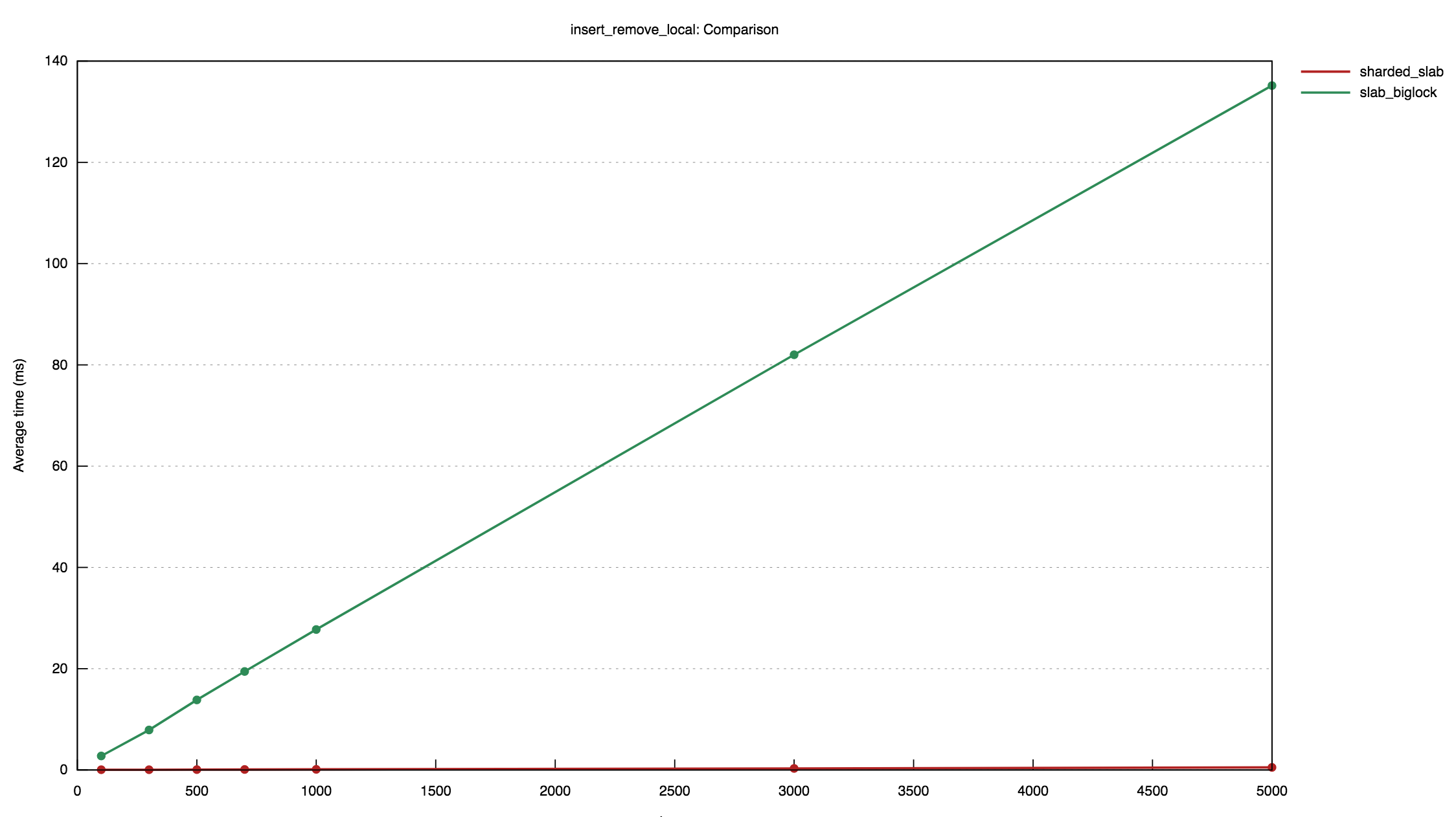
The first shows the results of a benchmark where an increasing number of
items are inserted and then removed into a slab concurrently by five
threads. It compares the performance of the sharded slab implementation
with a `RwLock<slab::Slab>`:

<img width="1124" alt="Screen Shot 2019-10-01 at 5 09 49 PM" src="https://user-images.githubusercontent.com/2796466/66078398-cd6c9f80-e516-11e9-9923-0ed6292e8498.png">

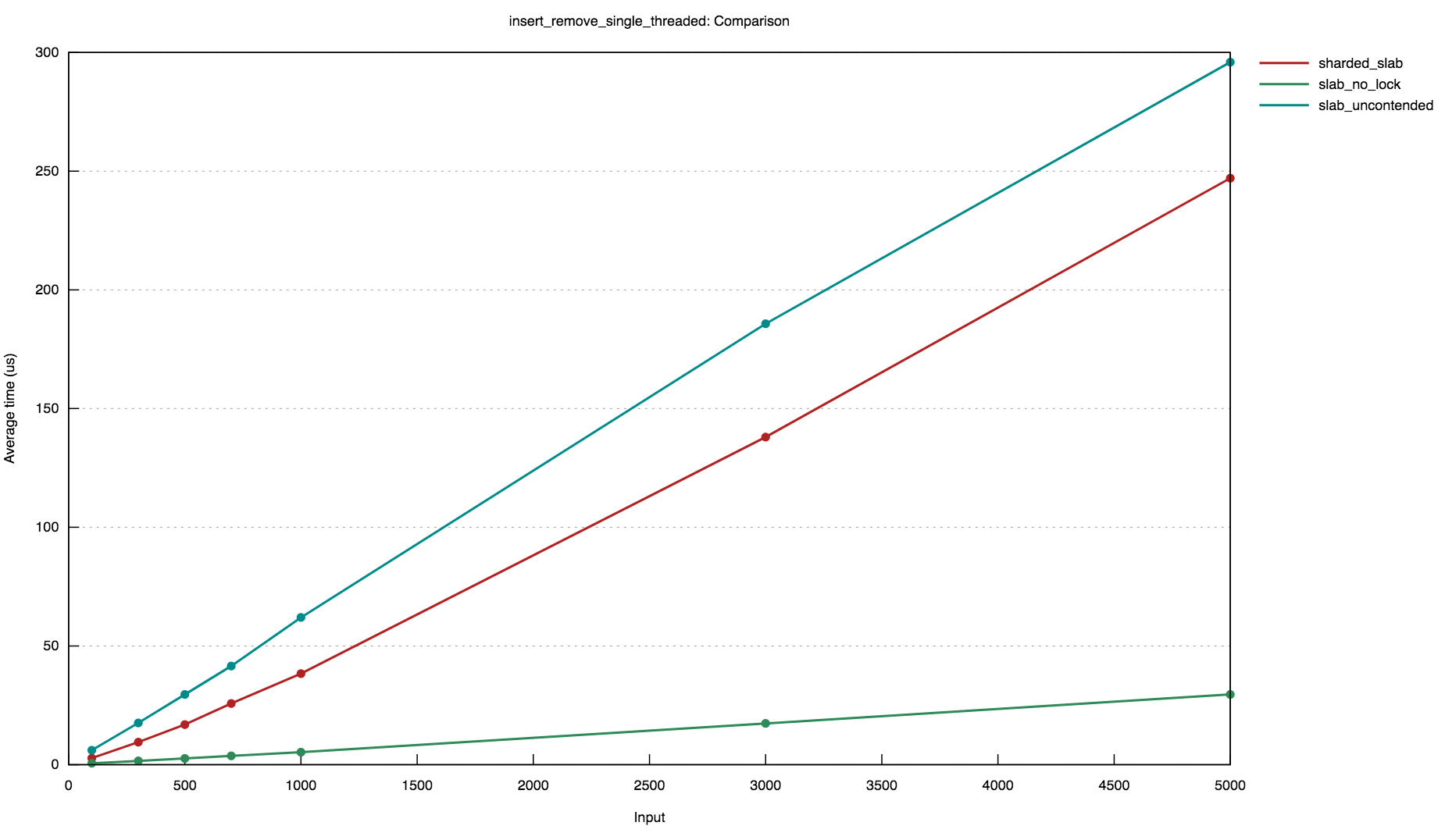
The second graph shows the results of a benchmark where an increasing
number of items are inserted and then removed by a _single_ thread. It
compares the performance of the sharded slab implementation with an
`RwLock<slab::Slab>` and a `mut slab::Slab`.

<img width="925" alt="Screen Shot 2019-10-01 at 5 13 45 PM" src="https://user-images.githubusercontent.com/2796466/66078469-f0974f00-e516-11e9-95b5-f65f0aa7e494.png">

Note that while the `mut slab::Slab` (i.e. no read-write lock) is
(unsurprisingly) faster than the sharded slab in the single-threaded
benchmark, the sharded slab outperforms the un-contended
`RwLock<slab::Slab>`. This case, where the lock is uncontended and only
accessed from a single thread, represents the best case for the current
use of `slab` in `tokio-net`, since the lock cannot be conditionally
removed in the single-threaded case.

These benchmarks demonstrate that, while the sharded approach introduces
a small constant-factor overhead, it offers significantly better
performance across concurrent accesses.

## Notes

This branch removes the following dependencies `tokio-net`:
- `parking_lot`
- `num_cpus`
- `crossbeam_util`
- `slab`

This branch adds the following dev-dependencies:
- `proptest`
- `loom`

Note that these dev dependencies were used to implement tests for the
sharded-slab crate out-of-tree, and were necessary in order to vendor
the existing tests. Alternatively, since the implementation is tested
externally, we _could_ remove these tests in order to avoid picking up
dev-dependencies. However, this means that we should try to ensure that
`tokio-net`'s vendored implementation doesn't diverge significantly from
upstream's, since it would be missing a majority of its tests.

Signed-off-by: Eliza Weisman <[email protected]>
A step towards collapsing Tokio sub crates into a single `tokio`
crate (#1318).

The `io` implementation is now provided by the main `tokio` crate.
Functionality can be opted out of by using the various net related
feature flags.
A step towards collapsing Tokio sub crates into a single `tokio`
crate (#1318).

The `net` implementation is now provided by the main `tokio` crate.
Functionality can be opted out of by using the various net related
feature flags.
 Ivan Petkov